


Pool coping is the row of stone, concrete or brick that caps the top of the pool wall, and it does three jobs at once: it gives swimmers a safe edge to hold, it stops water running in behind the shell, and it ties the pool into the paving around it.
For most Cape Town homes the choice comes down to precast concrete in a bullnose or square edge, or natural stone such as sandstone and travertine. Concrete coping starts from around R250 per linear metre at the time of writing (October 2026).
Below we compare the main profiles and materials, explain what replacement involves, and show a recent Kwik Pools job where we set new coping and re-paved the whole pool surround. If you already know you want work done, our pool paving and coping service page explains how we quote.
What pool coping actually does
Coping sits on the bond beam, the thick concrete ring at the top of the pool wall. It covers the joint between the shell and the paving so rain, pool water and garden runoff can’t soak straight down behind the wall. That joint is where many leaks and cracks start.
It also sets the look of the pool. Because coping is the first thing people touch when they climb out, grip and comfort matter as much as style.
- Safety: a firm edge to hold, with a non-slip top.
- Waterproofing: it sheds water away from the shell and bond beam.
- Structure: it protects the top of the wall and the waterline tiles.
- Finish: it frames the pool and links it to the paving or decking.
Pool coping profiles: bullnose, square edge and drop face
The profile is the shape of the front edge that overhangs the water.
Bullnose pool coping
Bullnose coping has a rounded front edge. It is the most common profile on older Cape Town pools and still the default for many family homes because it is kind on hands, arms and knees. The rounded lip makes a natural handhold.
Square edge coping
Square edge coping has a flat top and a sharp or slightly eased corner. It suits modern houses and rectangular pools, and it lines up neatly with large format paving slabs. We usually recommend a small arris (a softened corner) so the edge is less harsh underfoot.
Drop face coping
Drop face coping has a deeper vertical front, so the edge looks thicker than it really is. It is a design choice more than a practical one and works well with stone and porcelain paving where you want a solid, chunky edge.
Pool coping stones and materials compared
Material affects price, heat underfoot, slip resistance and how the coping copes with chlorine and salt air. Here is how the common pool coping stones compare.
| Material | Look | Good for | Watch out for |
|---|---|---|---|
| Precast concrete | Grey, white or tinted; bullnose or square | Most budgets, easy matching, simple repairs | Can fade and needs sealing in salt air |
| Sandstone | Warm natural tones, textured | Natural gardens, cool underfoot | Porous, needs regular sealing, can erode |
| Travertine | Light, natural, upmarket | Stays cooler in summer sun | Holes need filling, higher cost |
| Clay brick | Classic red or brown | Matching existing brick paving | Many joints, which loosen over time |
| Porcelain | Clean, modern | Contemporary pools | Needs a proper anti-slip grade |
Precast concrete is what we lay most often. It is affordable, comes in standard lengths that are easy to replace later, and can be colour-matched to new paving. Natural stone needs more care near the coast, where salt air also attacks metal fittings (see our note on coastal pool equipment corrosion).
Pool coping cost per metre
Pool coping cost is usually worked out per linear metre around the pool edge. Measure the perimeter of the pool and you have a rough idea of how much coping you need. If coping is one item on a longer list, our pool renovation checklist helps you plan the order of work. A typical rectangular family pool has a perimeter of around 20 to 30 metres.
| Job | Market price (October 2026) |
|---|---|
| Concrete coping, supply and lay | From around R250 per linear metre |
| Concrete coping, common range | R250 to R500 per linear metre |
| Coping replacement (general market) | R350 to R850 per metre |
| Coping replacement, Cape Town | R450 to R1,200 per metre |
| Paving lift and relay, Cape Town | R250 to R550 per m2 |
| Smooth slab paving, Cape Town | R300 to R420 per m2 |
| Travertine paving, Cape Town | R600 to R900 per m2 |
These are third-party market figures from Cape Town contractors and price guides, not Kwik Pools prices. Ask our team for a current quote, because the final figure depends on:
- The pool perimeter and how many corners, curves or steps it has.
- The material and profile you choose.
- Whether the old coping must be lifted and the bond beam repaired.
- Waterline tiles that get disturbed and need replacing.
- Access for barrows and rubble removal.
- Whether new paving is being laid at the same time.
We could not find reliable per-metre figures for sandstone or travertine coping on its own, so we price those per job once the stone has been chosen.
Thinking about new coping?
Send us a few photos of your pool edge and paving and we’ll tell you whether a repair or full replacement makes more sense.
When you need pool coping replacement
Coping usually fails slowly. One piece rocks when you step on it, a grout line opens up, then a corner chips off. Our guide to loose pool coping covers the early signs in more detail. Pool coping replacement is worth planning when you see:
- Several pieces that move or sound hollow when tapped.
- Cracks running from the coping down into the waterline tiles, which may need pool crack repair as well.
- Gaps where water can get in behind the pool wall.
- Chipped or spalled edges that could cut feet.
- Coping that has sunk or lifted out of line with the paving.
One or two loose pieces can often be re-bedded. When most of the edge is tired, it is cheaper over time to replace the lot, ideally at the same time as other pool renovations such as relining or resurfacing.
How we replace pool coping
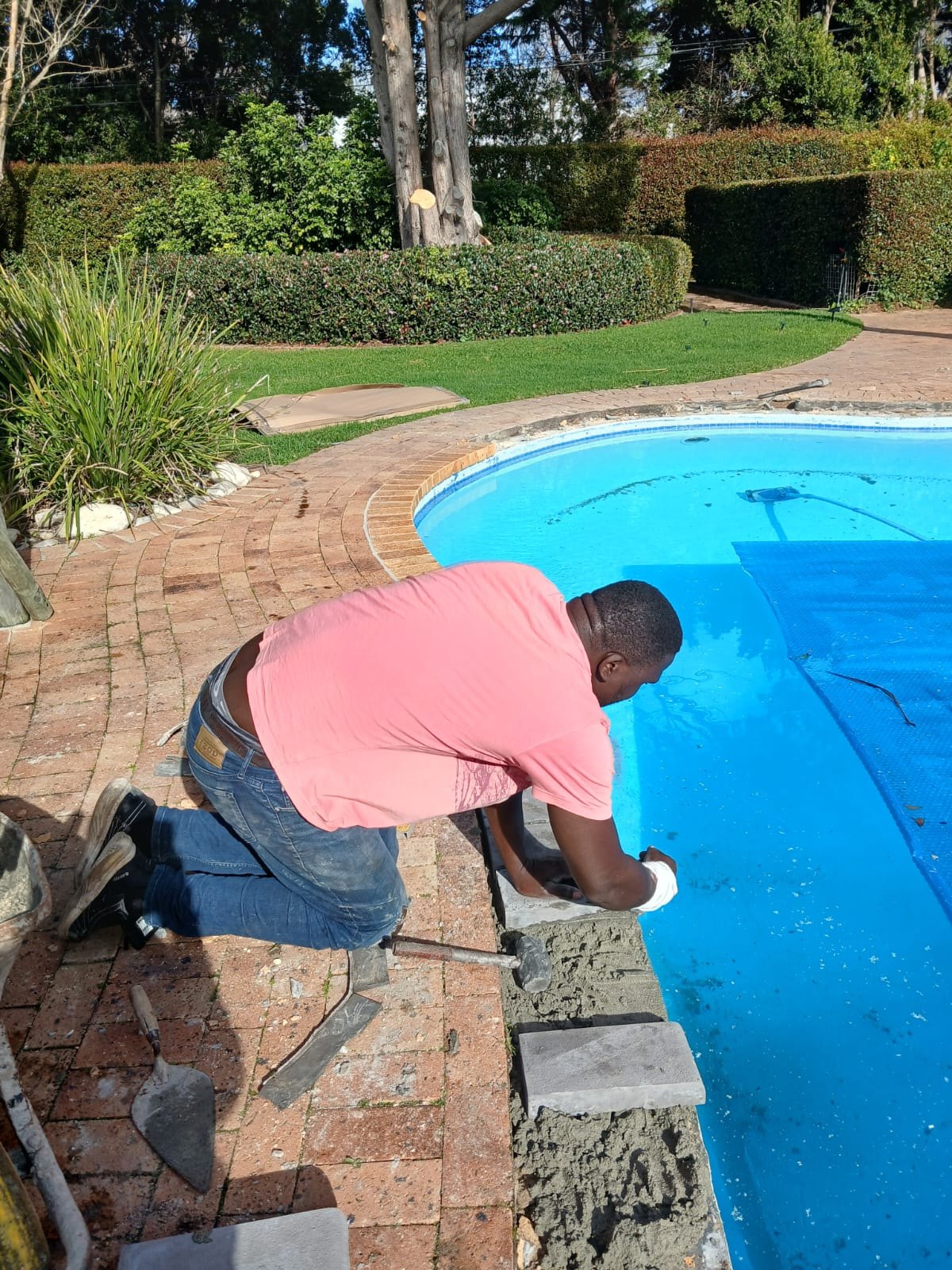
The water level comes down below the coping. We lift the old pieces carefully so we don’t crack the waterline tiles, chip off the old mortar and check the bond beam for cracks. New coping is then set on a fresh mortar bed with a slight fall away from the water, the joints are grouted and the paving joint is sealed. The mortar needs time to cure before anyone stands on the edge.
How coping ties into pool paving
Coping and pool paving should be planned as one job. The paving must fall away from the pool so rain and splash water drain into the garden, not into the pool or behind the coping.
Height matters too. The coping usually sits flush with or slightly above the paving so the pool edge is easy to see. Where paving meets decking, our comparison of timber vs composite pool decking explains how decking boards finish against coping.
Tip: if you plan to reline or resurface soon, do it before or together with new coping. The edge of a new lining tucks under the coping, so doing the coping first and the lining later can mean lifting new work.
A recent Kwik Pools pool coping and paving job
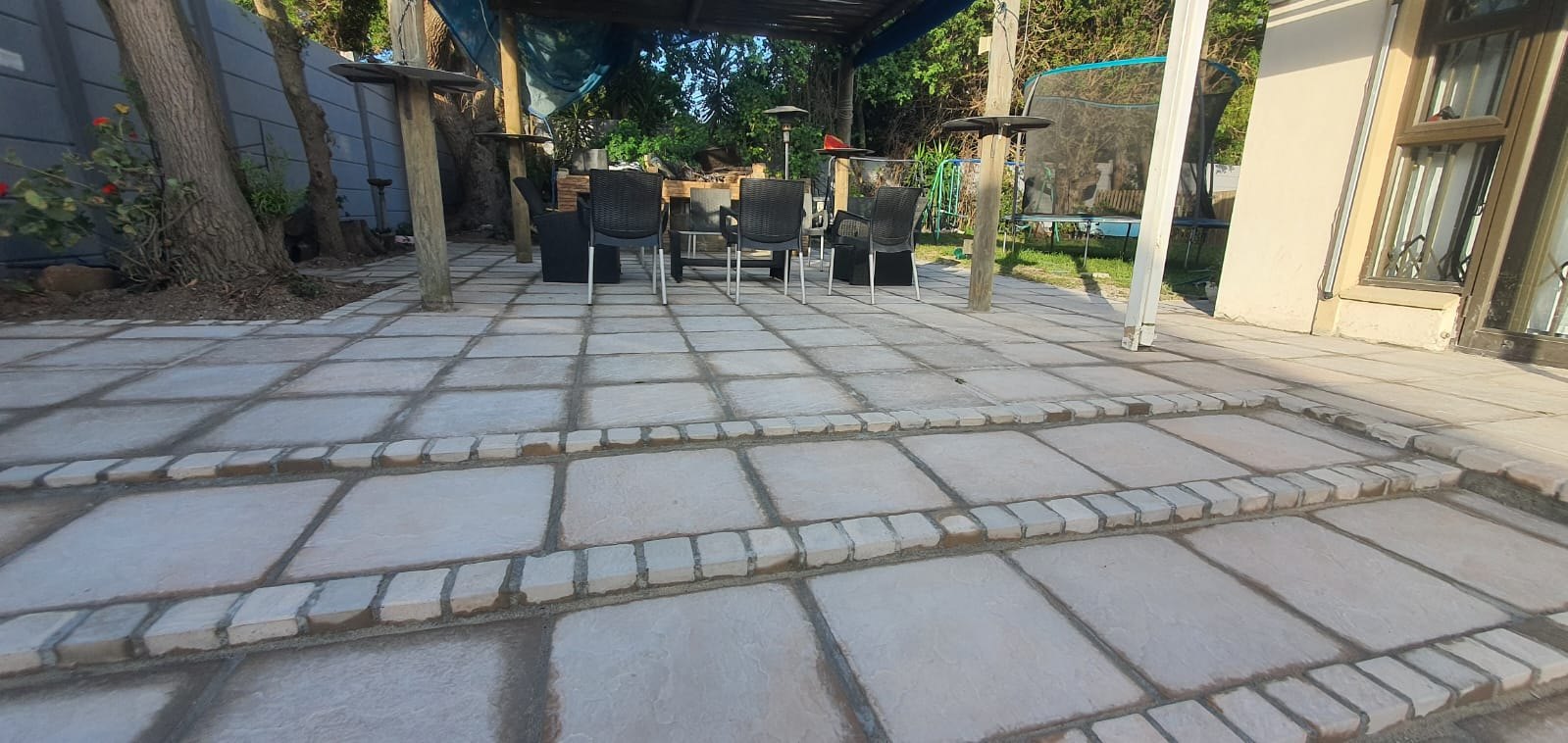
On a recent job our team relined a rectangular pool in bright blue with a mosaic waterline band and set new concrete coping slabs around the edge. We then lifted all the old paving around the pool and along the side of the house.

Once the ground was levelled and compacted, the pool surround and the side path were re-paved in large grey slabs with a cobble border. The square edge coping lines up with the big slabs, which keeps the look clean. You can see more about how relining fits into a job like this in our post on fibreglass pool relining cost.
Pool paving: Cape Town weather to plan for
Our climate is hard on pool paving. Cape Town winters bring heavy rain and runoff, so drainage falls and sealed joints matter. Summer wind blows sand and leaves into every open joint, and hot sun bakes dark paving until it is uncomfortable to walk on barefoot.
- Winter rain: make sure paving drains away from the pool and that the coping joint is sealed.
- Summer heat: lighter coloured stone and concrete stay cooler underfoot.
- Salt air: near the coast, seal concrete and natural stone so salt doesn’t break down the surface.
- Older pools: many older marbelite pools have original coping that is reaching the end of its life.
If your pool edge is still sound but the paving is uneven, a lift and relay can save money. We can also quote on pool decking if you’d prefer timber or composite on one side.
Choosing pool coping you won’t regret
Start with safety and maintenance, then style. A softened edge, a non-slip finish and a material you are happy to seal every few years will serve you better than the trendiest stone. Our pool coping and paving team can measure up and give you options at different price points.
Pool coping questions we hear often
What is the best pool coping for a Cape Town home?
For most family pools we suggest precast concrete in a bullnose or softened square edge, because it is affordable, easy to match and simple to replace one piece at a time. Sandstone and travertine look beautiful but need sealing and more care near the coast. The right choice also depends on the paving you already have or plan to lay.
How much does pool coping cost per metre?
At the time of writing (October 2026), concrete coping starts from around R250 per linear metre, with R250 to R500 a common range for the material and laying on a straightforward pool. Coping replacement in Cape Town is often quoted from around R450 to R1,200 per metre because it includes lifting the old pieces and repairing the bond beam. Ask our team for a current quote for your pool.
Can you replace pool coping without draining the pool?
Usually yes. We drop the water level a little below the coping so the mortar and grout stay dry while they cure. A full drain is only needed if the job also includes relining, resurfacing or tile work at the waterline.
Why is my pool coping coming loose?
The most common causes are tired mortar, water getting in behind the coping, ground movement and tree roots under the paving. Winter rain soaking the bedding and summer heat expanding the slabs both speed it up. A loose piece is a trip hazard, so it is worth fixing before it falls into the pool.
Should pool coping and pool paving match?
They don’t have to match exactly, but they should work together in colour, texture and height. Many homeowners choose a slightly lighter or contrasting coping so the pool edge is easy to see. What matters most is that the paving falls away from the pool so water drains off rather than back into it.
Get a quote for pool coping and paving
Tell us roughly how big your pool is, what is wrong with the edge and whether you want new paving too. We’ll arrange a visit and a written quote.


