

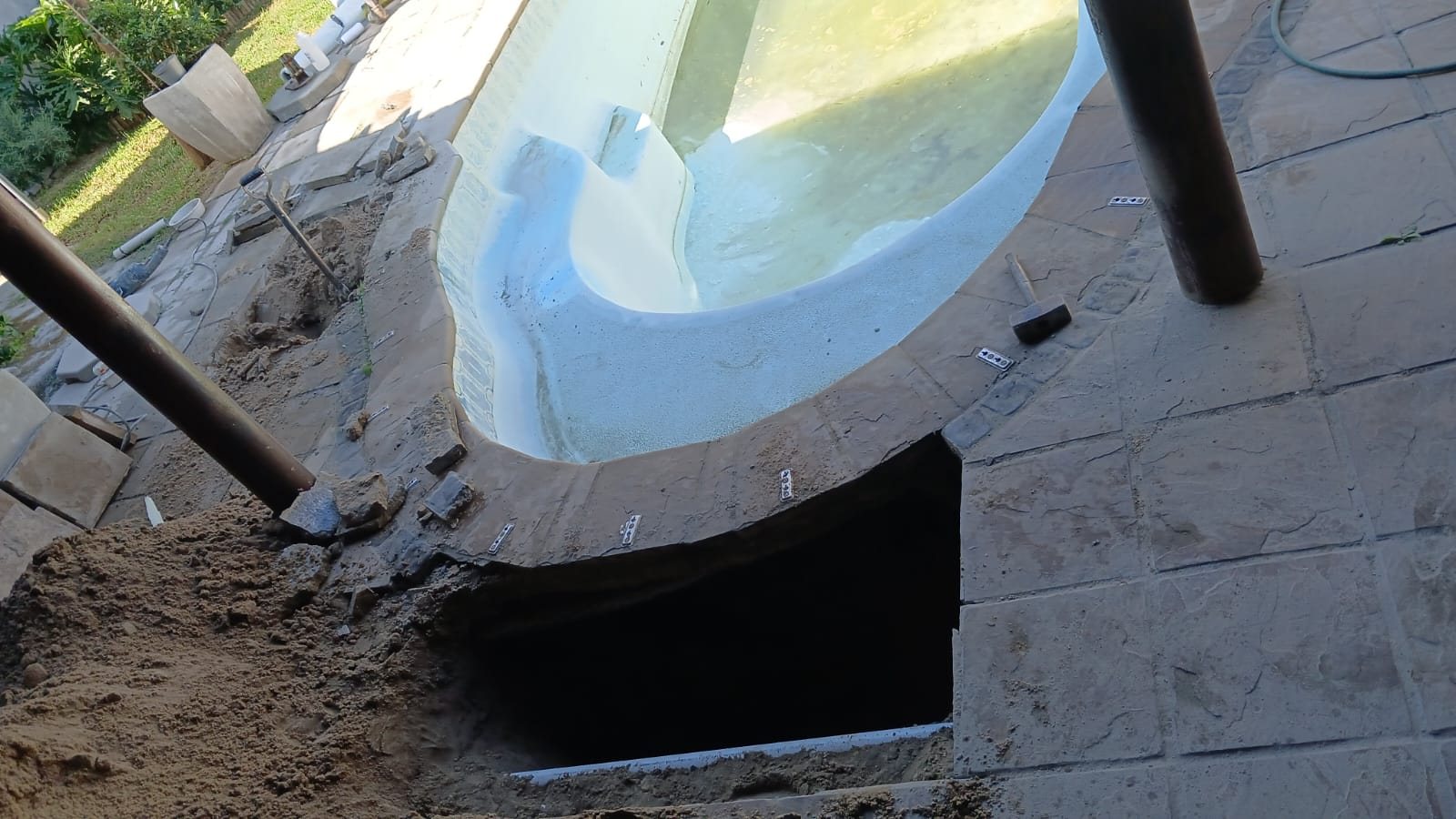
Loose pool coping should be treated as an unstable edge until it has been inspected. Keep people away from rocking slabs and raised trip points, photograph the affected area from firm ground and arrange an assessment of the coping, its support and the adjoining paving. Resetting a stone without understanding the movement can leave the real problem unresolved.
The immediate question is not which new paving looks best. It is whether the walking surface and the edge people grip are safe, and what needs repairing underneath. This guide separates useful observations from structural diagnosis so you can commission the right inspection.
Make loose pool coping safe to approach
Stop using the affected edge for sitting, jumping or climbing out. Keep children, visitors and pets away, including anyone who might approach the pool after dark. Use a safe alternative route around the area. A warning message alone is not enough if an unsuspecting person can still step onto a loose piece.
Do not stand on slabs to test how much they rock. Avoid lifting heavy coping yourself, particularly beside water or an unsupported opening. If a slab has already shifted, photograph it without putting hands beneath it. Sharp edges and unstable weight make a small-looking repair capable of causing injury.
Tell the person arranging pool paving and coping repairs that there is an access hazard, rather than describing the job only as cosmetic. Explain whether the affected section blocks the usual entrance, ladder or step area so the visit can be planned sensibly.
Map sunken pool paving without dismantling it
Take one wide photograph showing the relationship between the pool, coping and surrounding paving. Then take closer pictures of the dips or raised edges from a stable position. Include a fixed reference such as a step or doorway, rather than photographing an isolated crack that cannot be located later.
Record what changed first. Did paving settle before a coping joint opened? Was the area recently excavated for pipes? Did a patch hold for a while and then move again? These details help the assessor choose an investigation, but none proves that the pool shell itself is moving.
- Identify which stones appear displaced without deliberately loading them.
- Photograph puddles during ordinary rainfall only when it is safe.
- Note water reaching the area from irrigation, a downpipe or cleaning.
- Record nearby excavations and previous repairs if you know about them.
- Keep dated photographs to show whether the pattern is changing.
Depressions in paving can hold water and create trip points. However, a wet patch might have several sources, and a dry day does not establish that the bedding is sound. Let the assessor distinguish what can be seen on the surface from what requires controlled lifting or further testing.
Separate pool edge movement from surface settlement
Coping is the finishing edge at the top of the pool. The surrounding pavement and the pool structure are not automatically one continuous construction. An assessor should consider how the coping is supported, how adjoining materials meet and whether damage extends into the tiled edge or shell.
Ask them to explain the evidence for their recommendation. Local bedding failure, a poorly supported paving area and movement involving the pool structure require different scopes. A photograph of a rocking slab cannot reliably distinguish all three, especially where the supporting construction is hidden.
What cracked coping stones can tell you
Record whether a crack stays within one piece, crosses several joints or continues into the tile band. Also note whether faces are displaced relative to each other. Do not label a fine crack harmless or a wider one structural from appearance alone. Its location, history and associated movement matter.
If unexplained water loss accompanies the edge damage, request pool leak detection as a separate part of the discussion. Replacing paving is not evidence that a plumbing leak has been found, and a new coping joint is not a promise that the pool will hold water.
The contractor may need to expose a limited area before confirming the extent of work. Agree where that investigation will start, how the site will be left safe and how additional repairs will be approved. Avoid an open-ended instruction to replace whatever looks old.
Start with the unstable edge
Send an overview, close-ups and the location of the unsafe access point so we can discuss an assessment.
Ask how pool expansion joints will be handled
A movement joint is not simply an untidy gap waiting for hard filler. Its design allows adjoining construction to behave as intended. TAL’s residential pool mosaic guidance requires underlying structural and construction joints to continue through the tiled assembly rather than being bridged by the finish.
That principle does not supply a universal coping-joint width or sealant specification. Ask the installer to identify the construction and propose the appropriate detail. Joint position, material compatibility and exposure must suit the actual pool, not an unrelated sketch found online.
Manufacturer distinctions are useful here. Sakrete describes a flexible sealant for horizontal concrete joints, while distinguishing it from a non-sag product for vertical seams. This illustrates why orientation and movement matter; it is not a recommendation to use that product in a submerged pool or on every coping material.
If a quote says only “fill all gaps”, ask which are ordinary joints and which are movement joints. Confirm that the proposed repair will preserve the required movement detail. Also ask how the installer will deal with old, incompatible repair materials rather than simply covering them.
Include pool paving drainage in the inspection
Look at the path water takes around the area rather than just the lowest puddle. Useful evidence includes where roof runoff arrives, whether a drain is visibly obstructed and whether water collects against the pool edge. You do not need to flood the patio to create a test.
Ask the contractor to assess surface falls, drainage outlets and the support beneath affected paving. The purpose is to identify an appropriate repair for the particular pavement and site. No universal slope or bedding recipe can be specified safely without knowing how this area was built.
Where coping meets timber or composite boards, include the pool decking interface in the assessment. A moving deck board is not the same fault as a loose coping stone, but the junction may affect access and how the repair is finished.
Do not dig alongside the shell or beneath the paving to investigate a suspected washout yourself. Hidden pipes, unsupported edges and other services can complicate excavation. Share any drawings or photographs of earlier pipework so the contractor can plan investigation with fewer unknowns.
Compare reinstatement scopes, not just replacement stones
| Item | Decision to record |
|---|---|
| Extent of removal | Which coping and paving areas will be opened, and why? |
| Underlying support | How will exposed bedding or base defects be assessed and corrected? |
| Drainage and joints | Which details need repair, and what specification will apply? |
| Reuse or replacement | Can sound pieces be reused, and what happens if removal breaks them? |
| Safe reopening | Who confirms that the repaired area is ready for foot traffic? |
Ask for separate allowances for essential stabilisation and optional appearance changes. This keeps an urgent safety repair from becoming an unplanned redesign. There is no reliable standard price for an unknown support problem, so compare the work included rather than an unsupported cost per stone.
Check how colour and size differences will be handled if replacement pieces are needed. Existing paving may have weathered, and a new batch may not match perfectly. A sample or proposed layout can make that compromise clear before the pool edge is dismantled.
- Agree the unsafe area and temporary access arrangements.
- Approve the initial inspection and any controlled opening.
- Review the findings and revised repair scope before extra work.
- Confirm material, joint and drainage details in writing.
- Inspect the completed work and obtain reopening instructions.
Prepare for the visit and final checks
For pool services in Erinvale, share any visitor-entry procedure, delivery restrictions and safe access route when arranging the assessment. If materials must pass through the home or a narrow side entrance, mention that before equipment arrives.
Do not empty the pool to help the paving contractor. Ask whether any water-level change is genuinely needed and who is qualified to plan it. Edge repairs and interior repairs can have different access requirements, and unnecessary draining introduces a separate set of risks and responsibilities.
At handover, review the listed areas together. Ask how the repaired surface was checked, whether drainage was assessed and which maintenance instructions apply to the installed materials. Follow the specified waiting period before foot traffic; a surface that looks dry is not automatically ready for use.
Questions about unstable pool edges
Does loose coping mean the pool shell is cracked?
No. Loose coping can involve its support or adjoining construction, and a photograph cannot establish the cause. Damage continuing into the pool or recurring movement warrants a broader assessment rather than an automatic structural diagnosis.
Can the original coping stones be reused?
Possibly, if they remain suitable and can be removed without unacceptable damage. Ask the contractor to separate reuse assumptions from replacement allowances. Matching older pieces may also affect the finished appearance.
Should every gap be filled with mortar?
No. Movement joints have a different role from ordinary rigid joints. The repair specification should identify both and use appropriate materials rather than filling every visible line in the same way.
Will relaying the paving solve nearby water loss?
Not by itself. Water loss needs its own investigation where the cause is unknown. Paving repairs can address the walking surface and support, but they do not establish that a leak has been located or repaired.
Plan a stable edge and a clear handover
Discuss the inspection findings, repair boundaries and safe access before choosing replacement finishes.


Comments are closed