


Calcium hardness in a pool is the amount of dissolved calcium in the water, and for most marbelite and plaster pools it should sit between 200 and 400 ppm. Too low and the water eats into your pool surface and grout. Too high and it leaves white scale on tiles and equipment.
In Cape Town the usual problem is the first one. Our tap water is very soft, and winter rain makes it softer still. Below we explain the target ranges, how to spot both problems, how to raise hardness with calcium chloride and how to bring it down. If you’d rather hand it over, our pool water testing and balancing service covers the full set of readings.
What calcium hardness in a pool actually measures
Calcium hardness is measured in parts per million (ppm), expressed as calcium carbonate. Your test kit or strip reads it alongside pH, total alkalinity and chlorine. It changes slowly, so most home pools only need it checked once a month, plus after heavy rain or a big top-up.
Water wants to hold a certain amount of dissolved calcium. If it has less than it wants, it takes calcium from whatever it touches: the marbelite, plaster, grout and tile adhesive. If it has more than it can hold, the extra drops out as a hard white crust. Getting calcium hardness right keeps the water from doing either.
Ideal calcium hardness ranges by pool surface
The right level depends on what your pool is lined with. Cement-based surfaces need more calcium in the water to stay protected than smooth, non-porous ones.
| Pool surface | Calcium hardness target | Why |
|---|---|---|
| Marbelite or plaster | 200 to 400 ppm (aim for 250 to 300) | Cement-based, so soft water dissolves it |
| Tiled or mosaic concrete | 200 to 400 ppm | Protects grout and adhesive |
| Fibreglass | 175 to 225 ppm | Non-porous, but very low levels can still affect fittings |
| Painted (epoxy or rubber) | Follow the paint maker’s guide | Coatings vary |
| Salt chlorinated pool | Lower half of the range for your surface | High calcium scales up the salt cell |
Under about 150 ppm, water is generally considered aggressive. Above about 500 ppm, scaling becomes likely, especially if pH and alkalinity are high too.
Pool water too soft: the Cape Town problem
Cape Town’s municipal water is among the softest you’ll find. The City’s own tap water reports show total hardness of roughly 18 to 39 mg/l across its supply systems. That’s a fraction of what a marbelite pool needs, so a pool filled or heavily topped up from the tap starts well below target.
Winter makes it worse. Heavy rain falls straight into the pool, runoff washes in from the paving and the overflow takes treated water away. Each rainy season dilutes calcium, alkalinity and pH together. Our article on pool overflow after heavy rain explains what that does to the rest of your chemistry.
When pool water is too soft, these are the signs we see most:
- A rough, sandpaper feel on the floor and steps, which can scuff feet. See our guide to a rough pool surface.
- Grout lines between waterline tiles going sandy and recessed, the start of pool grout wearing away.
- Marbelite turning blotchy or patchy, with the aggregate starting to show.
- Fine white or grey dust settling on the floor, especially after a new surface.
- Metal fittings, ladders and heat exchangers corroding faster than they should.
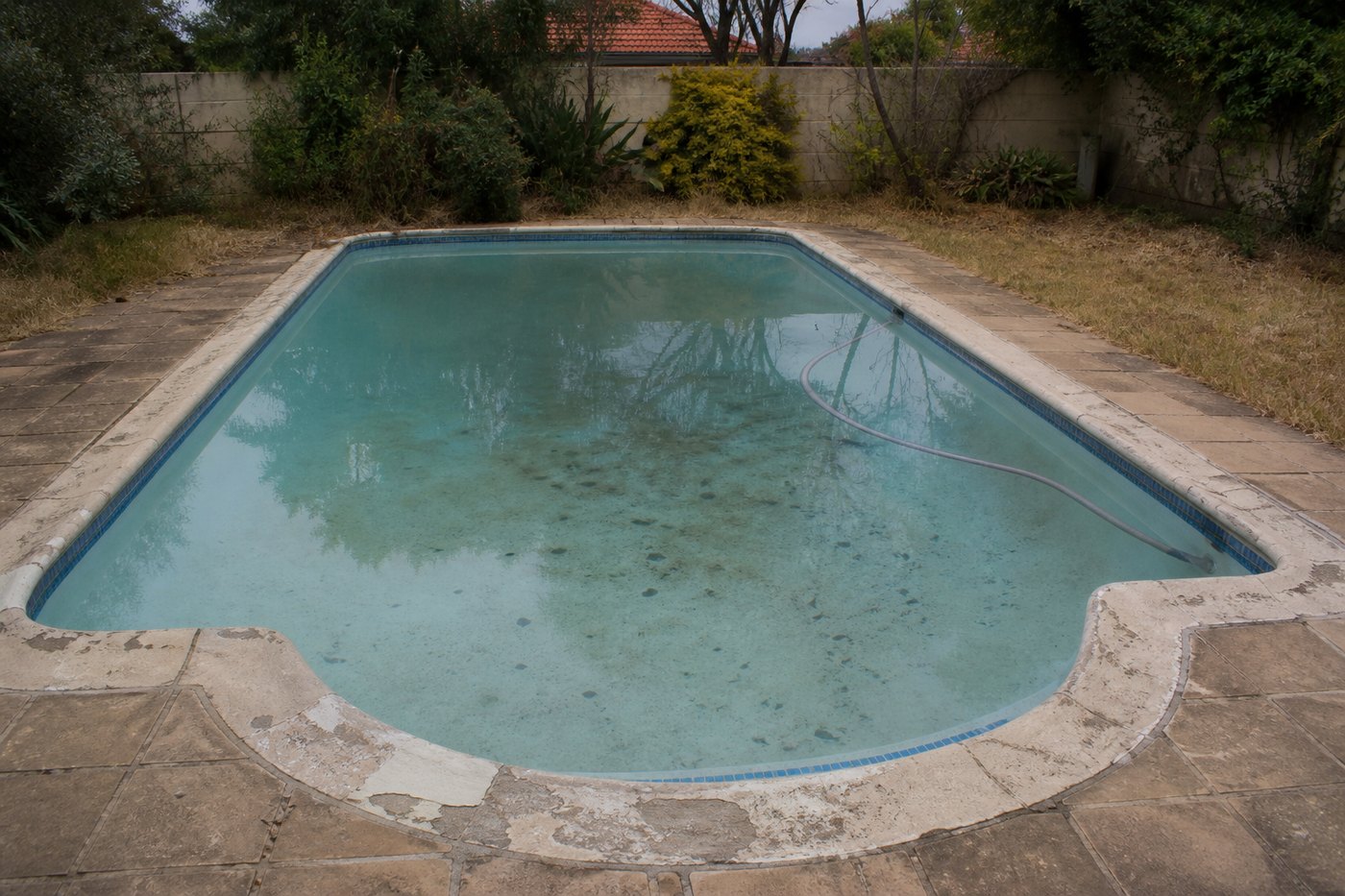
Etching from soft water is permanent. You can stop it getting worse, but you can’t put the lost surface back without marbelite resurfacing. That’s why keeping calcium up matters most in older marbelite pools.
Pool scale: when calcium hardness is too high
High calcium is less common in Cape Town but it does happen. Pools that have been topped up for years without draining, pools treated with lots of calcium hypochlorite (granular chlorine), and pools that evaporate heavily in summer all build calcium over time.
Pool scale shows up as a white or grey crust, usually along the waterline tiles where water evaporates and leaves minerals behind. It also forms inside salt chlorinator cells, on heat pump exchangers and in the filter. Cloudy water that won’t clear even with good chlorine can be another sign.
Scale on a salt cell is a big one. It insulates the plates and cuts chlorine output, which can look like a faulty chlorinator. If yours seems weak, read salt chlorinator not producing chlorine before buying a new cell.
Scale needs three things. High calcium on its own rarely causes scale. It’s high calcium plus high pH plus high alkalinity together. Bringing pH back to 7.2 to 7.6 is usually the fastest way to stop new scale forming while you deal with the calcium.
Not sure what your readings mean?
We test calcium hardness, pH, alkalinity, chlorine and salt on site, explain the results and balance the water for you.
How to raise calcium hardness with calcium chloride
Calcium hardness is raised with calcium chloride, sold as hardness increaser in flakes or granules. The common pool grade is 77% calcium chloride. As a working guide, about 1.5g of 77% calcium chloride raises 1,000 litres by 1 ppm.
| Pool | Current | Target | Rise | Approx. calcium chloride |
|---|---|---|---|---|
| 40,000 L | 150 ppm | 250 ppm | 100 ppm | About 5.9kg |
| 50,000 L | 200 ppm | 250 ppm | 50 ppm | About 3.7kg |
Need your litres? Our pool volume calculator works it out from the pool’s length, width and depth. Then dose like this:
- Test calcium, pH and alkalinity first. Adjust pH and alkalinity before calcium, and never on the same visit. Our pool alkalinity guide covers that step.
- Run the pump and keep children and pets away from the pool area.
- Wear gloves and eye protection. Fill a plastic bucket with pool water, then slowly add the calcium chloride to the water, never the other way round. It gets hot as it dissolves.
- Add only half the calculated dose. Pour the dissolved solution slowly around the deep end, away from the skimmer.
- Brush the floor and leave the pump running for at least 24 hours.
- Retest and add the rest if you’re still short. It’s easy to add more and hard to take it out.
Products differ in strength, so always follow the label on your bag. Don’t mix calcium chloride with any other chemical, and add one product at a time.
How to lower calcium hardness in a pool
There’s no chemical that properly removes calcium. The only reliable way to lower calcium hardness is dilution: drain part of the water and refill with softer water. In Cape Town, that softer water comes straight out of the tap, so even a 20 to 30% partial drain makes a real difference.
Before draining, check the water restrictions in force and where the water may go, and never drain a marbelite or fibreglass pool completely without advice, because an empty shell can be damaged by groundwater pressure. While you wait for a refill, keep pH low in the range so the calcium stays dissolved. Our guide on how to lower pH in a pool explains the acid steps safely.
Calcium hardness in a pool and water balance (the LSI)
Calcium hardness doesn’t work alone. Pool professionals use the Langelier Saturation Index (LSI) to combine pH, alkalinity, calcium, temperature and dissolved solids into one number that says whether water is likely to etch or scale.
In plain terms: an LSI below about -0.3 means the water is aggressive and will etch, and above about +0.5 it’s likely to scale. Near zero is balanced. That’s why a pool with low calcium can still be fine if pH and alkalinity are a bit higher, and why cold winter water is more aggressive than the same water in summer.
You don’t need to calculate the LSI yourself. Just keep pH at 7.2 to 7.6, alkalinity in its range and calcium hardness on target. If you’ve just had a new surface or reline, follow the new marbelite pool aftercare steps, because fresh marbelite is most vulnerable to soft water in its first weeks.
Calcium hardness in a pool: common questions
What should calcium hardness in a pool be?
For marbelite, plaster and tiled concrete pools, aim for 200 to 400 ppm, with 250 to 300 ppm a comfortable middle. Fibreglass pools are usually kept lower, around 175 to 225 ppm. Check your surface supplier’s guide if the pool was recently relined or resurfaced.
How much calcium chloride do I add to raise calcium hardness?
As a guide, about 1.5g of 77% calcium chloride raises 1,000 litres by 1 ppm. So a 50,000 litre pool needs roughly 3.7kg to go up 50 ppm. Add half, circulate for a day, retest and then top up, and always follow the product label.
How do you lower calcium hardness in a pool?
The only reliable way is dilution: drain part of the pool and refill with softer water. Cape Town’s municipal water is very soft, so a partial refill brings hardness down quickly. Keep pH and alkalinity in range in the meantime so the calcium stays dissolved.
Why is my pool water too soft in Cape Town?
Cape Town’s tap water carries very little calcium, typically under 40 mg/l of total hardness, and winter rain dilutes the pool further. Pools filled or heavily topped up with municipal water often start well below 200 ppm. Soft water then pulls calcium out of marbelite and grout.
What is the white crust on my pool tiles?
It’s usually calcium scale, which forms when hardness, pH and alkalinity are high together. It builds up most where water evaporates at the waterline. Bring the pH down first, then have it cleaned off without damaging the tiles.
If your test kit is giving you numbers you’re not sure about, our water balancing team can test, explain and correct them in one visit.
Book a water test
Tell us your pool type, size and suburb. We will test the full balance, including calcium hardness, and let you know what it needs.


