

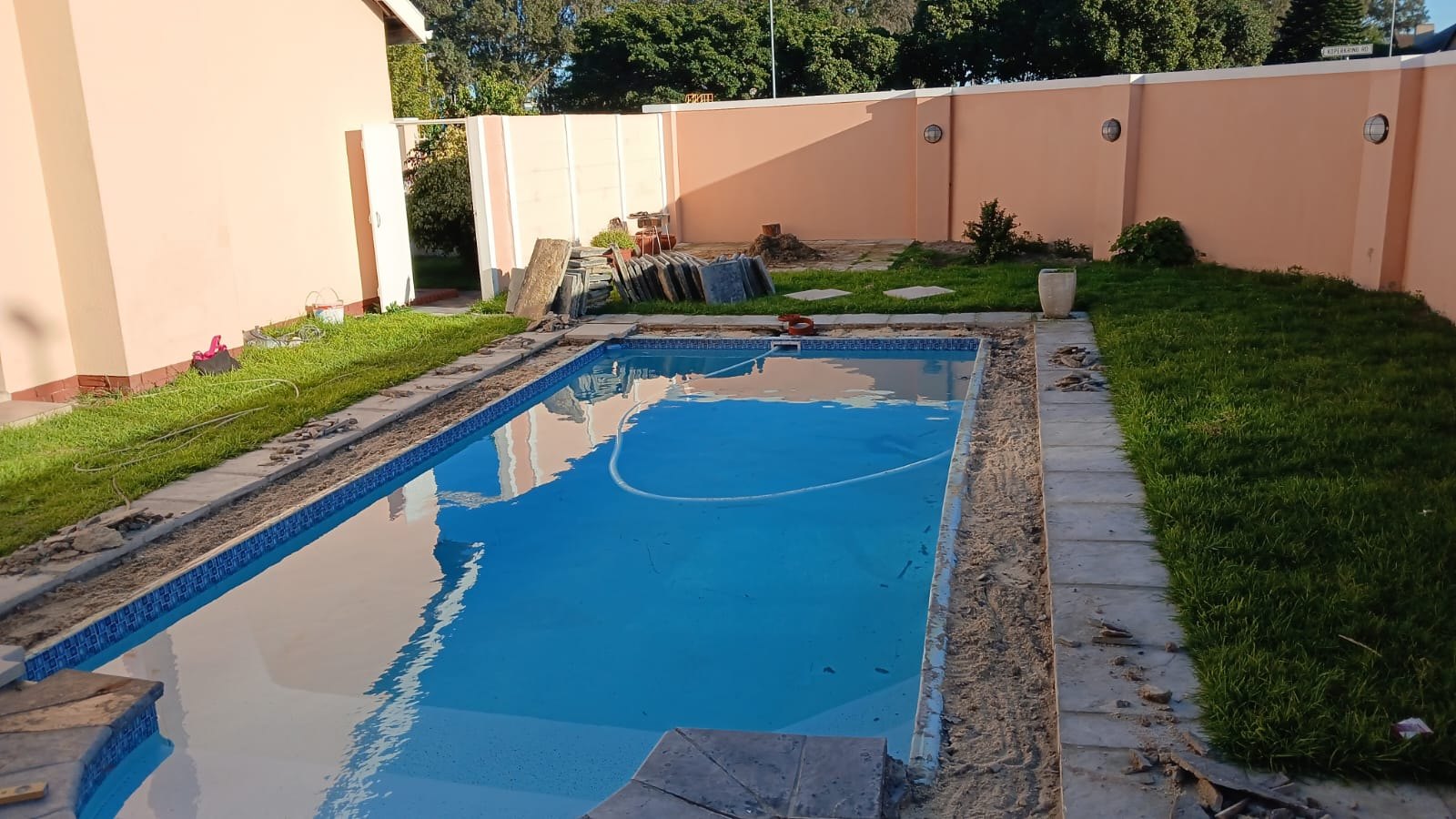
For a pool volume calculator, litres are a useful output only when the shape and depth you enter are reliable. Measure the water space in metres, choose a suitable geometric model and use an average depth that represents the whole floor. The result estimates water volume, not the chemical dose or permission to add a product.
The most useful number is not necessarily the one with the most decimal places. A carefully measured rectangular pool can be represented simply. A kidney-shaped pool with broad steps, benches and a changing floor needs more judgement. Keep the measurements and assumptions with the result so another person can check them.
Pool volume calculator: litres, inputs and limits
The calculator supports a rectangle, a circle and an ellipse. Enter full length for a rectangle or ellipse, full diameter for a circle, and full width where required. Depth must be the average water depth, not the wall height above the floor. All dimensions are in metres and the result is in litres.
Do not select ellipse merely because the pool has curved edges. A true ellipse is a particular shape, not every oval-looking outline. Rounded-end rectangles, kidney pools and freeform designs can differ substantially from that model. The calculator cannot see your pool and does not correct for steps or sloping walls automatically.
For pool water testing and balancing, bring the calculation record as well as the latest readings. Tell the adviser whether the volume came from dimensions, installation records or a measured fill. Describing an estimate honestly is safer than presenting an uncertain figure as a measured capacity.
Measure the water space without creating a hazard
Start with plans or an installation record if available, but check whether the dimensions refer to the shell, the coping or the water space. A plan may also predate added steps or a renovation. Do not assume an advertised pool size is the usable internal length and width.
Measure from stable, accessible positions and obtain help where needed. Do not lean over a deep edge, climb onto a cover, enter restricted water or lower conductive measuring equipment near electrical hazards. If a safe measurement is not practical, have a pool professional obtain it rather than draining the pool to make the arithmetic easier.
- Sketch the water outline and label the shallow end, deep end, steps and benches.
- Record internal water length and width, with the units written beside each number.
- Identify whether the floor is flat, continuously sloped or divided into different zones.
- Choose a model and record features that it does not represent.
- Check the resulting litres against available installation or filling records.
Use the normal operating waterline as the reference for depth. Measuring from the top of the coping can include space that contains air rather than water. Note the water level on the day, especially if it is unusually low. Do not compensate for uncertainty by quietly changing a dimension until the answer looks familiar.
Rectangular pool volume and a checked example
Rectangular pool volume equals internal length multiplied by internal width multiplied by average water depth. With each measurement in metres, the multiplication gives cubic metres. Multiply that result by 1,000 to express it in litres. Do not combine centimetres and metres in the same formula.
For a simple example, take a pool measuring 7 metres by 3 metres with an average water depth of 1.4 metres. Its modelled volume is 7 × 3 × 1.4 = 29.4 cubic metres, or 29,400 litres. This is an illustrative calculation, not the measured capacity of a Kwik Pools project.
A box model assumes essentially vertical sides and an appropriate average depth. Broad submerged seating displaces water that the box counts as present. Significant sloping walls also reduce the match between a rectangular outline and the actual water space. Record these limitations before using the result in a treatment consultation.
If your records describe a pool after pool renovations, check whether steps, benches or shape changes were included. A redesigned shallow area can matter more to capacity than a superficial change of colour. Retain the updated sketch rather than relying forever on a number written down before the work.
Average pool depth is not always the midpoint
Need help with the next step?
Bring your dimensions and water-test results to a consultation before selecting a treatment.
Average pool depth can be the mean of shallow and deep depths when the floor slopes uniformly across a constant-width footprint. For shallow and deep depths of 1.0 and 1.8 metres, that mean is 1.4 metres. The assumption matters as much as the arithmetic.
A pool with a long flat shallow section and a shorter deep section is different. Treating only its two endpoint depths as representative may overestimate or underestimate the true volume. The more defensible approach is to split the footprint into zones whose area and average depth can each be described.
Consider two simplified flat zones: one is 4 metres by 3 metres at 1 metre deep, and the other is 3 metres by 3 metres at 1.8 metres deep. Together they contain 28,200 litres. Using the endpoint mean over the whole 7-by-3 footprint gives 29,400 litres instead. Neither model describes a real transition unless that transition is also accounted for.
This example explains why a depth entered to two decimal places is not automatically accurate. If the wrong floor model is chosen, additional decimal places merely disguise the uncertainty. Ask for professional measurement when the deep hopper, sloping sides or transition geometry cannot be represented confidently.
Round pool volume and elliptical outlines
Round pool volume uses the circle’s area: pi multiplied by radius squared, then by average depth. Radius is half the diameter. The calculator asks for diameter and handles that conversion internally. Entering the radius in its diameter field produces the wrong area, even though the result may look plausible.
For a circular water space 4 metres across and 1.2 metres deep, the estimated volume is about 15,080 litres. The calculation uses the mathematical constant pi rather than a rough shape allowance. The rounded display does not imply the physical pool was measured to the nearest litre.
For a true ellipse, area is pi multiplied by half the full length and half the full width. An ellipse 8 metres long, 4 metres wide and 1.5 metres deep holds about 37,699 litres under that model. Check that the depth assumption remains appropriate; an elliptical outline does not solve an irregular floor.
| Shape model | Area calculation | Important limitation |
|---|---|---|
| Rectangle | Length × width | Steps and sloping sides are not automatically deducted |
| Circle | Pi × radius × radius | Diameter must span the full water space |
| Ellipse | Pi × half-length × half-width | Not a universal model for rounded or kidney pools |
Irregular pool volume and displaced water
Irregular pool volume is often best approached with a non-overlapping plan sketch. Divide the footprint into simpler areas, estimate each area’s representative depth and add their volumes. Do not count the same curved section twice or include paving outside the waterline just because it completes a convenient rectangle.
Steps and benches require particular care. Deduct only the solid volume that your base model has incorrectly counted as water. If the zone measurements already follow the actual stepped water space, deducting the steps again would double-correct the answer. Write down which method you used so the logic can be reviewed.
Do not apply an arbitrary percentage deduction to every freeform pool. The amount of displaced water depends on its actual geometry. Where the shape cannot be reasonably represented, label the result provisional and ask for a survey or a better measurement method before relying on it for treatment planning.
If a refill is already necessary and professionally authorised, a meter can provide useful evidence when other consumption is separated out. Cemcrete’s PoolCrete start-up guide specifically discusses using a meter reading to verify volume. This is not a reason to drain a sound pool purely to measure it.
Keep the pool litres calculation separate from dosing
A pool litres calculation supplies one input to treatment decisions. It does not identify the product strength, current concentration, desired change or compatibility with the finish and equipment. A volume figure cannot tell you whether chlorine, salt, acid or any other chemical is needed.
- Write down the shape model and units, not just the final number.
- Keep uncertain depth or step assumptions visible.
- Use current water tests and the actual product label for treatment advice.
- Do not combine chemical products or use the calculator as a mixing recipe.
For pool services in the City Bowl, send the sketch and available dimensions before requesting measurement help. Explain any narrow access, restricted poolside working space or missing records. This lets the assessment focus on the measurement problem rather than repeating a generic capacity guess.
If unexpected water loss prompted the calculation, pool leak detection addresses a different question. Capacity is the water held by the pool; it does not establish where water is going. Keep volume estimates and water-loss observations separate in the enquiry so the right investigation can be discussed.
Frequently asked questions
Does the calculator tell me how much chlorine to add?
No. It estimates volume only. Treatment also depends on current tests, the desired change, the exact product and its label instructions, plus compatibility with the pool finish and equipment.
Can I average only the shallow and deep ends?
Only when that average represents the floor geometry, such as a uniform slope across a constant-width footprint. Pools with flat zones, hoppers or broad steps need a more suitable model.
Should I enter radius or diameter for a round pool?
Enter the full diameter in the calculator. The code divides it by two to obtain radius. Using radius in the diameter field gives an incorrect result.
Should I drain my pool to measure it accurately?
No. Use safe dimensional measurements, existing records or professional assistance. A measured fill is useful only when refilling is already necessary and professionally authorised.
Talk through your pool requirements
Contact Kwik Pools with your observations, photographs and questions. Ask what an assessment should cover and which records will help.


Comments are closed