

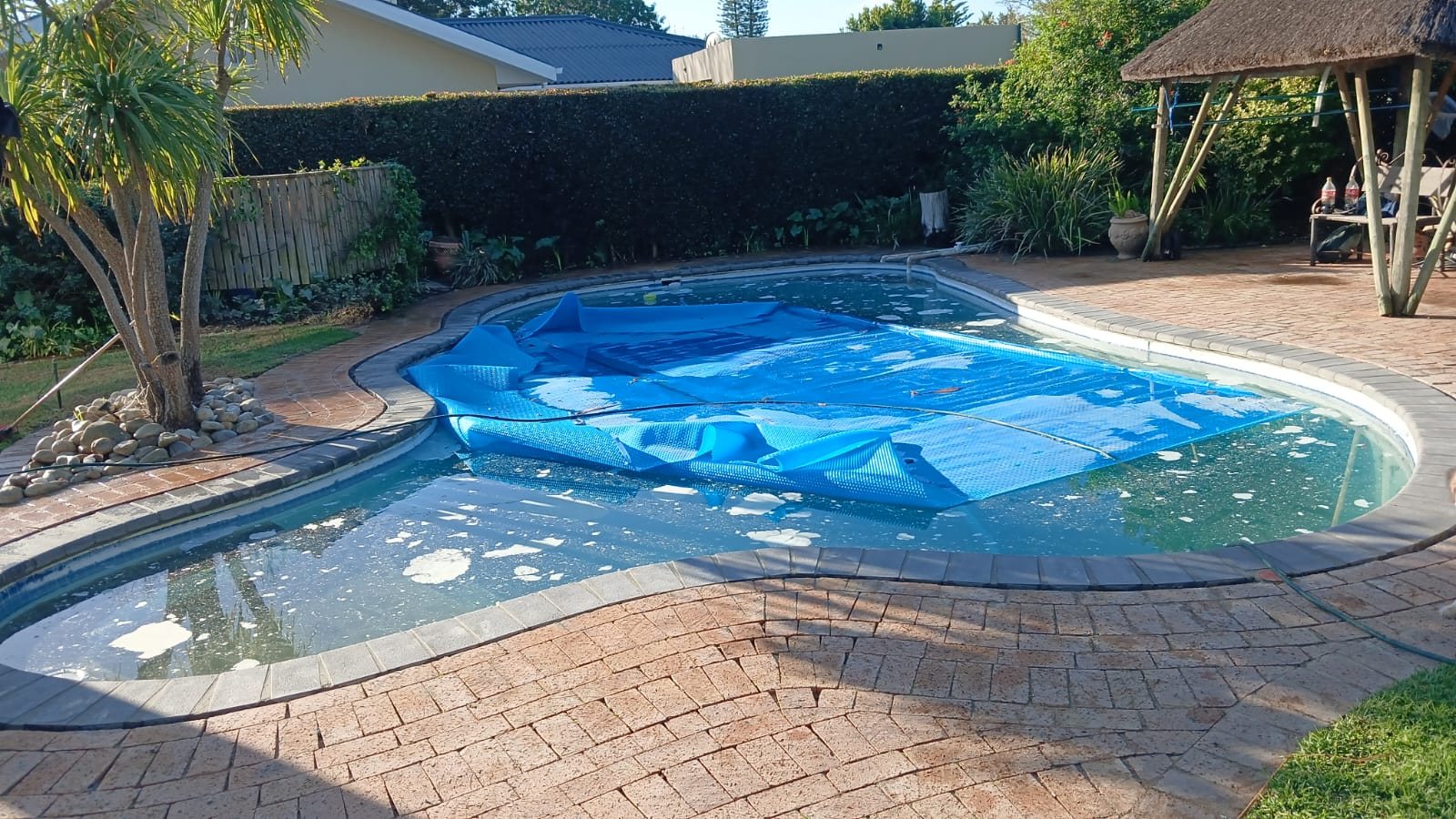
Solar pool cover bubbles up or down? Down. The bubble side goes against the water and the smooth side faces the sky. That’s how every manufacturer we know of tells you to fit it, and it’s how the cover traps heat and stops evaporation properly.
Fitting it the right way round is the easy part. Below we cover why the bubbles go down, how much warmth a solar blanket actually adds, how much water it saves, and how to stop the south-easter from turning it into a kite. If you’d rather we measure and fit it, see our pool cover installation service.
Solar pool cover bubbles up or down: why down is right
A bubble blanket is two layers of UV-stabilised plastic welded together, one flat and one shaped into small air pockets. Laid bubbles down, those pockets sit on the water and form a layer of trapped air between the pool and the cold night sky.
That air layer is the insulation. It slows heat leaving the water, and it stops water vapour escaping. Sunlight still passes through the clear or light-blue plastic and warms the water directly under it.
Flip the cover bubbles up and three things go wrong:
- The smooth side sits on the water, so there’s less trapped air doing the insulating.
- The bubbles face the sun and UV directly, so they go brittle and pop sooner.
- Leaves and dust collect between the bubbles, which makes the cover harder to clean and blocks light.
New covers can look a bit flat when they come out of the box. The bubbles expand once the sun warms them for a few days, so don’t take a flat-looking side as a sign it’s the top.
Fitting a solar pool cover the right way
A solar pool cover works best when it’s cut to the shape of your pool, so it floats right to the edges without riding up onto the coping. Here’s the usual method for a new cover:
- Unroll it on the water with the bubbles facing down and leave it to float for two or three sunny days. This lets the packaging creases relax and the plastic settle.
- Smooth it out so it covers the whole surface, with the excess lying up over the coping.
- Mark the line where the cover meets the inside edge of the pool wall with a marker.
- Pull the cover off and cut it on a lawn or soft surface, slightly outside the line. Don’t cut it on the pool, because blades can scratch the surface or tiles.
- Float it again for a day and trim any edges that still ride up.
- Cut a neat gap around the skimmer mouth if needed, so the cover doesn’t get sucked into the weir.
Solar pool cover bubbles up or down: a quick check
Unsure which face is which on an old cover? Run a hand over both sides. The side with the raised air pockets goes on the water, and the flat, slightly shiny side faces up.
Freeform and kidney pools are fiddly to mark, and a badly cut cover blows around and wears fast at the corners. That’s one of the jobs our team does for you when we supply and fit.
Solar cover heat gain: how fast does it warm a pool?
Here’s the honest answer: a pool blanket is better at keeping heat in than adding it. The sun already does most of the heating. Outdoor pools absorb roughly 75 to 85% of the solar energy that hits the surface, and a clear bubble cover only reduces that absorption by around 5 to 15%. What the cover adds is the overnight insulation, so the warmth gained during the day stays put.
Solar cover heat gain therefore depends on how long the cover stays on. Test figures from the Florida Solar Energy Center put the gain at roughly 3°C with the cover on 12 hours a day and around 5 to 6°C at 20 hours a day. Some local suppliers claim up to 8°C. In practice, you’ll usually notice the difference after two or three sunny days.
| Effect | Typical figure | What changes it |
|---|---|---|
| Water warming | About 3°C (12 hours on) to 5 or 6°C (20 hours on) | Sun hours, wind, pool depth |
| Evaporation while covered | Up to about 95% less | How well the cover fits the edges |
| Top-up water over a season | 30 to 50% less | How often the cover is on |
| Chemical use | 35 to 60% less | Sun exposure, swimmer load |
| Heating costs (heated pools) | 50 to 70% less | Heater type, cover hours |
If you heat the pool with a heat pump or solar panels, a cover is the cheapest way to make that heat last. Our pool heating page and our guide to heat pumps vs solar heating explain how the systems work together.
Clear or blue? Clear covers let a bit more sunlight reach the water, so they warm slightly faster. Blue and darker covers hold heat a little better and slow algae growth by blocking some light. For most Cape Town pools, the difference is smaller than the difference good fitting makes.
Pool evaporation: how much water a pool blanket saves
Pool evaporation is the biggest way a pool loses both heat and water. Each litre that evaporates takes a lot of energy out of the water with it, which is why an uncovered pool cools quickly on a dry, windy night.
A well-fitted pool blanket can prevent up to about 95% of evaporation while it’s on. Over a full season, with the cover off for swimming and cleaning, a 30 to 50% cut in top-up water is more realistic. That matters in Cape Town, where the City has urged pool owners to cover pools during water restrictions, and where water tariffs climb steeply once a household goes over 10.5kl a month.
Less evaporation also means steadier chemistry. Chlorine burns off more slowly under a cover, and leaves and dust stay out of the water. If your pool loses more water than a cover can explain, though, you may have a leak. A simple pool bucket test tells you which.
Want a solar cover cut to fit?
We measure your pool, supply the blanket and cut it to shape, including freeform and kidney pools. Ask about a roller while we are there.
Wind, rollers and storing your pool blanket
Cape Town’s summer south-easter is the one thing that makes a bubble blanket hard work. A cover that’s cut too small, or left half-rolled at one end, catches the wind and can end up in the garden or wrapped around the fence.
A few habits help:
- Cut it to the edges. A cover that reaches the walls sits on the water and is hard for wind to lift.
- Use a roller. A roller on a stand at one end makes it a one-person job and keeps the cover tidy. Mount it on the side of the pool that faces away from the prevailing wind if you can.
- Shade it when it’s off. A rolled cover in full sun gets very hot between the layers. Use a reflective sleeve or store it in the shade.
- Don’t drag it. Pulling the cover across rough paving or sharp coping tears the bubbles.
- Clean it now and then. Hose off dust and leaves before rolling. Our guide on how to clean a solar pool cover covers this.
The south-easter also blows a lot of dust and leaves around, so the cover saves you skimming time too. Our article on wind-blown debris in your pool has more on that.
Solar pool cover, chlorine, salt and lifespan
A covered pool loses much less chlorine to sunlight. That’s good for your chemical bill but it means the dosing has to come down, or the extra chlorine gets trapped under the cover and slowly bleaches it.
- If you have a salt chlorinator, turn its output or run time down after fitting a cover, then test and adjust. See our salt chlorinator service if yours needs looking at.
- Take the cover off before shocking the pool and leave it off until chlorine is back in the normal range.
- Don’t leave a floating chlorine dispenser under the cover. It parks in one spot and burns a hole in the plastic.
- Keep pH balanced. Water that’s out of balance for weeks makes the cover go brittle and flake.
Expect a decent bubble blanket to last roughly three to five years, depending on thickness and care. Thicker 500 micron covers generally outlast cheaper thin ones. When the bubbles start popping and the plastic flakes into the filter, it’s time for a new one.
At the time of writing (October 2026), SA suppliers list 500 micron solar bubble blankets from around R99 per m2 for the material, with most in the R99 to R166 per m2 range. Fitting and a roller are extra. Our pool cover prices guide breaks down the options, and you can ask our team for a current quote.
One last point: a solar pool cover is not a safety device. A child or pet can slip under it and can’t be seen. If you need a barrier, compare the types of pool covers and look at our pool safety nets and fencing.
Solar pool cover bubbles up or down, and other questions
Solar pool cover bubbles up or down?
Bubbles down, touching the water, with the smooth side facing the sky. The air in the bubbles insulates the pool and lets sunlight warm the water underneath. Upside down, the cover wears faster and holds less heat.
How fast does a solar cover heat a pool?
You’ll usually notice a difference after two or three sunny days with the cover on. Published test figures put the gain at roughly 3°C with the cover on 12 hours a day and about 5 to 6°C at 20 hours a day. Cloud, wind and how many hours it stays on all change the result.
How much does a pool blanket stop evaporation?
A well-fitted bubble cover can prevent up to about 95% of evaporation while it’s on the pool. Over a whole season, with the cover off for swimming, savings of 30 to 50% in top-up water are more realistic.
Should I take the solar cover off when I add chlorine?
Yes, take it off before shocking or adding a big chlorine dose, and leave it off until levels are back in the normal range. High chlorine trapped under the cover bleaches and weakens the plastic. Also turn a salt chlorinator down, since a covered pool loses far less chlorine to the sun.
Is a solar pool cover a safety cover?
No. A bubble blanket can’t hold the weight of a child or a pet, and someone underneath it can’t be seen. For child safety you need a compliant fence plus a safety net or rigid safety cover.
Ready to cut your top-ups and keep the water warmer for longer? Our team handles solar cover fitting for all pool shapes, and can add a roller at the same time.
Get a solar cover fitted
Tell us your pool size and shape and your suburb. We will measure, quote and fit a cover that stays put in the wind.


