


Borax in a pool raises the pH without pushing total alkalinity up much, and at higher doses it builds up borates, which help hold the pH steady. As a rough guide, about 150g of borax per 10,000 litres lifts the pH by around 0.2 when alkalinity is normal. Add it in steps, retest after six hours and never treat it as a cure for green water.
Borax is sodium tetraborate, the same white powder sold for laundry. It’s useful, but it’s a balancing chemical, not a sanitiser. If your readings won’t settle, our pool water testing and balancing service can work out what’s really going on.
What borax in a pool actually does
Borax has two jobs in pool water, depending on how much you use:
- Small doses raise the pH. Borax is alkaline (a solution sits at about pH 9.2), so a few hundred grams nudges a low pH back up.
- Large doses build borates. Kilograms of borax, plus acid to bring the pH back down, give you a borate level of 30 to 50 ppm. Borates act as a second buffer that resists pH rising.
Most homeowners only need the first job. The second is a longer-term change to how your water behaves, and it’s worth understanding before you buy a big bag.
Borax pH: how to raise pH without alkalinity going up
The usual pH increaser is soda ash. It works fast, but it also raises total alkalinity quite a lot. If your alkalinity is already in the 80 to 120 ppm range, or high, adding soda ash pushes it higher and the pH starts creeping up on its own. Borax lets you raise pH without alkalinity jumping, because it shifts the pH more than it adds to the alkalinity reading.
That’s the main reason to reach for borax. If both pH and alkalinity are low, you don’t need it: bicarbonate lifts alkalinity first, and our guide on how much baking soda to add to a pool has the sums. If the pH is high instead, see how to lower pH in a pool.
How much borax in a pool to raise pH?
There isn’t an exact figure, because alkalinity and existing borates change how far each gram moves the pH. Use this as a starting point, then test:
| Pool size | Borax, first dose | Then |
|---|---|---|
| 10,000 L | About 150g | Retest after 6 hours |
| 30,000 L | About 450g | Retest after 6 hours |
| 50,000 L | About 750g | Retest after 6 hours |
| 80,000 L | About 1.2kg | Retest after 6 hours |
If the pH has moved less than you hoped, add another dose of the same size. If it’s overshot past 7.6, stop and let it settle; don’t chase it straight back down with acid. Know your volume first: the pool volume calculator gives you litres from the pool’s length, width and depth.
Not sure which chemical your pool needs?
We test pH, alkalinity, calcium, stabiliser and chlorine together, then tell you what to add and in what order. Send us your latest readings.
Borates in pool water: the 30 to 50 ppm buffer
The pool industry recommends borate levels of 30 to 50 ppm when you use them as a buffer, with 50 ppm the accepted maximum. At that level, borates resist the pH rising. That’s helpful in pools where pH climbs all the time, such as salt pools and pools with waterfalls or spa spillovers. If you’re planning a salt water pool conversion, borates are one way to cut down the weekly acid.
Reaching 30 to 50 ppm takes a lot of borax. Published dosing charts put it at roughly 900g of borax per 10,000 litres for every 10 ppm of borates. A 50,000 litre pool going from zero to 40 ppm would need around 18kg of borax, plus pool acid in stages to bring the pH back down from where the borax pushes it. Boric acid can be used instead to avoid most of the acid, but it costs more.
Borates don’t evaporate or break down. They leave only when water leaves: backwashing, splash-out and, in Cape Town, winter rain overflowing the pool. Once you’ve built the level up, a small top-up once a year is usually enough, and testing for borates needs a specific test strip.
Before you build borates: it’s a big chemical change that is hard to undo without draining water. Get a full water test first, and make sure alkalinity, calcium and stabiliser are right. Borates won’t fix a pool that is out of balance in other ways.
How to add borax to a pool safely
Borax dissolves slowly in cold water, so dissolve it first. Late afternoon is a good time, when nobody needs to swim for a while.
- Test pH and total alkalinity. Only use borax if pH is below 7.2 and alkalinity is in range.
- Switch the pump on and leave it running.
- Put on gloves and eye protection.
- Half fill a clean plastic bucket with warm water and add the measured borax to the water, stirring until it dissolves. Never pour water onto the powder.
- Pour the mix slowly around the deep end, in front of a return jet and away from the skimmer.
- Run the pump for at least six hours, then retest before adding more.
Note the dose and the reading afterwards; our weekly pool maintenance checklist has space for exactly that. If you’re also adding acid to build borates, do it at a different time, on a separate day if you can, and in a different part of the pool. Never mix borax, acid and chlorine together in a bucket, and add one product at a time.
Store borax sealed and out of reach. It shouldn’t be swallowed, so keep children and pets away while you dose, and discourage dogs from drinking pool water once borates are in. Buy pool-grade borax or plain laundry borax with no added soap, perfume or brighteners.
Borax and Cape Town pool water
Cape Town’s municipal water is generally soft, and winter rainwater is softer still. Soft water tends to pull pH and alkalinity down after a wet spell, which is exactly when owners start looking for a pH increaser. If alkalinity has dropped too, start with bicarbonate; if alkalinity is fine and only the pH is low, borax is the gentler choice.
Rain also matters if you’ve built up borates. When a cold front overfills the pool and it spills over, or you run the pump to waste to drop the level, some borates go with the water. Test borates at the start of summer and top up only what’s missing. In summer, the south-easter churns the surface and speeds up the pH rise, so a borate buffer can help windy, exposed pools hold their pH between visits.
Borax vs soda ash: which pH increaser?
| Borax | Soda ash | |
|---|---|---|
| Raises pH | Yes, gently | Yes, strongly |
| Raises alkalinity | Very little | Noticeably |
| Clouding risk | Low | Can cloud water if overdosed |
| Amount needed | More per dose | Less per dose |
| Extra benefit | Builds borate buffer over time | None |
At the time of writing (October 2026), SA online shops list small packs of borax powder from around R59 and 1kg bags from around R179, with bigger bags cheaper per kilo. For small pH corrections, either product works. Ask our team for a current quote if you’d like us to do the balancing for you.
Borax pool algae claims: what borates can and can’t do
You’ll read that borax kills algae. It doesn’t. The pool industry describes borates as an algaestat: at 30 to 50 ppm they may help slow algae growth and lower chlorine demand, but they won’t clear a pool that’s already green. Borax pool algae treatment is really a chlorine job.
For green water, you need a proper chlorine shock, brushing and filtering. A floor like the one below needs chlorine and elbow grease, not borax. Our guide to how much shock to add to a pool has the doses. If the algae returns every few weeks, read about a green pool that keeps coming back, since the cause is usually low chlorine, poor circulation or high stabiliser.
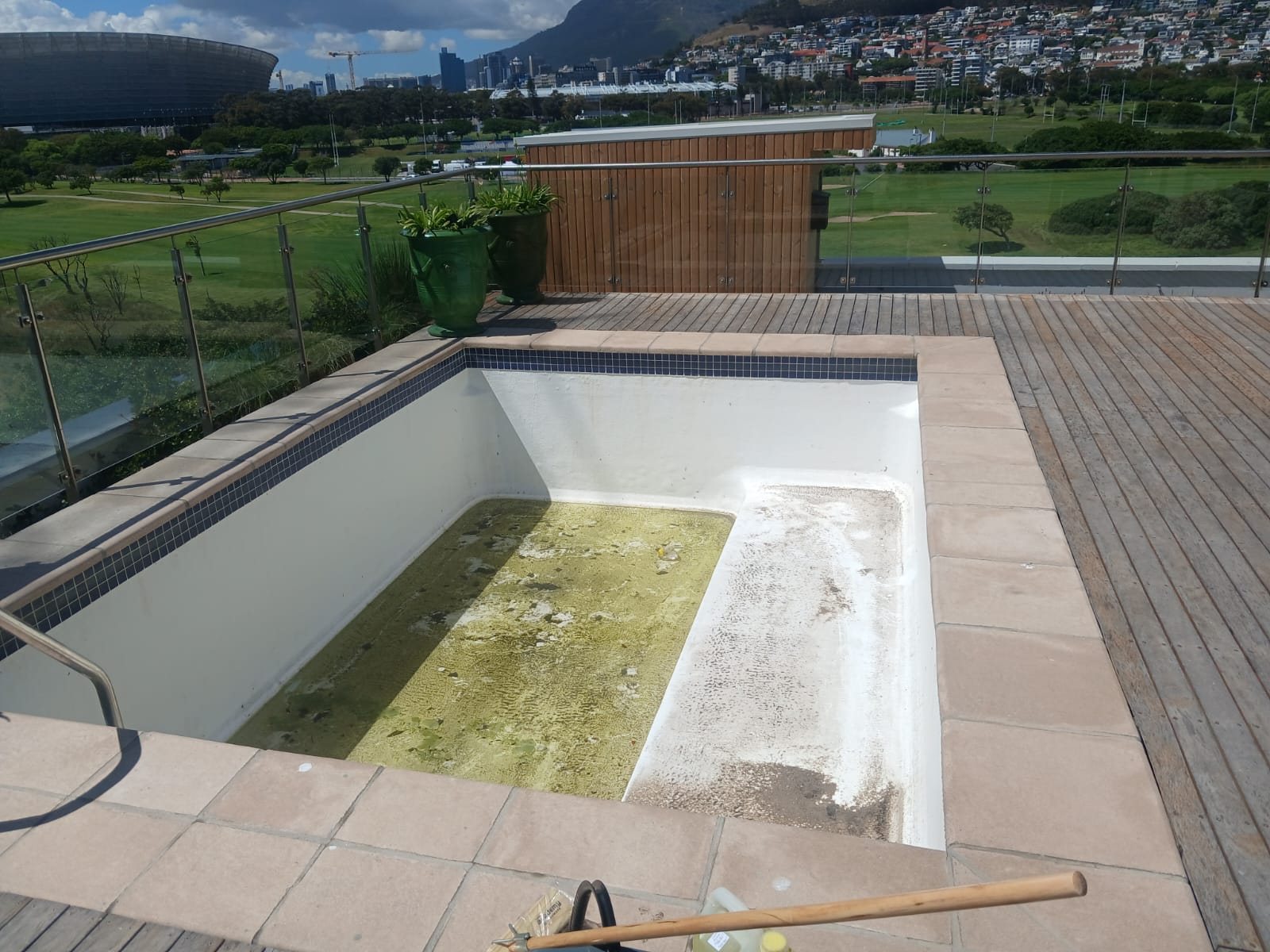
Regular pool maintenance matters more than any additive. Steady chlorine, the right pH and a clean filter keep most pools clear, with or without borates.
Borax in a pool: common questions
Is borax in a pool safe?
Used at pool doses and dissolved properly, borax is a common pool chemical. Wear gloves and eye protection when handling the powder, keep it away from children and pets and don’t let dogs drink pool water with borates in it.
How much borax to add to a pool to raise pH?
As a guide, about 150g per 10,000 litres raises pH by around 0.2 when alkalinity is normal. For a 50,000 litre pool that’s about 750g. Dissolve it first, add with the pump running and retest after six hours.
What does borax do for a pool?
It raises pH with little change to alkalinity, and at higher doses it builds borates, which buffer the pH against rising. Borates may also help reduce algae growth and chlorine demand.
Can I use laundry borax in my pool?
Yes, as long as it is plain sodium tetraborate with no added soap, perfume or brighteners. Pool-grade borax is the same chemical.
Will borax clear a green pool?
No. Borax is not a sanitiser or algaecide. A green pool needs a chlorine shock, brushing and filtering, and borates can only help slow algae down once the water is clear.
If you’d prefer a professional to set up the chemistry, our water balancing visits include pH, alkalinity, calcium and stabiliser checks.
Get your water balanced
We test, correct and explain what keeps pushing your readings out of range. Book a visit or send us your test results.


