

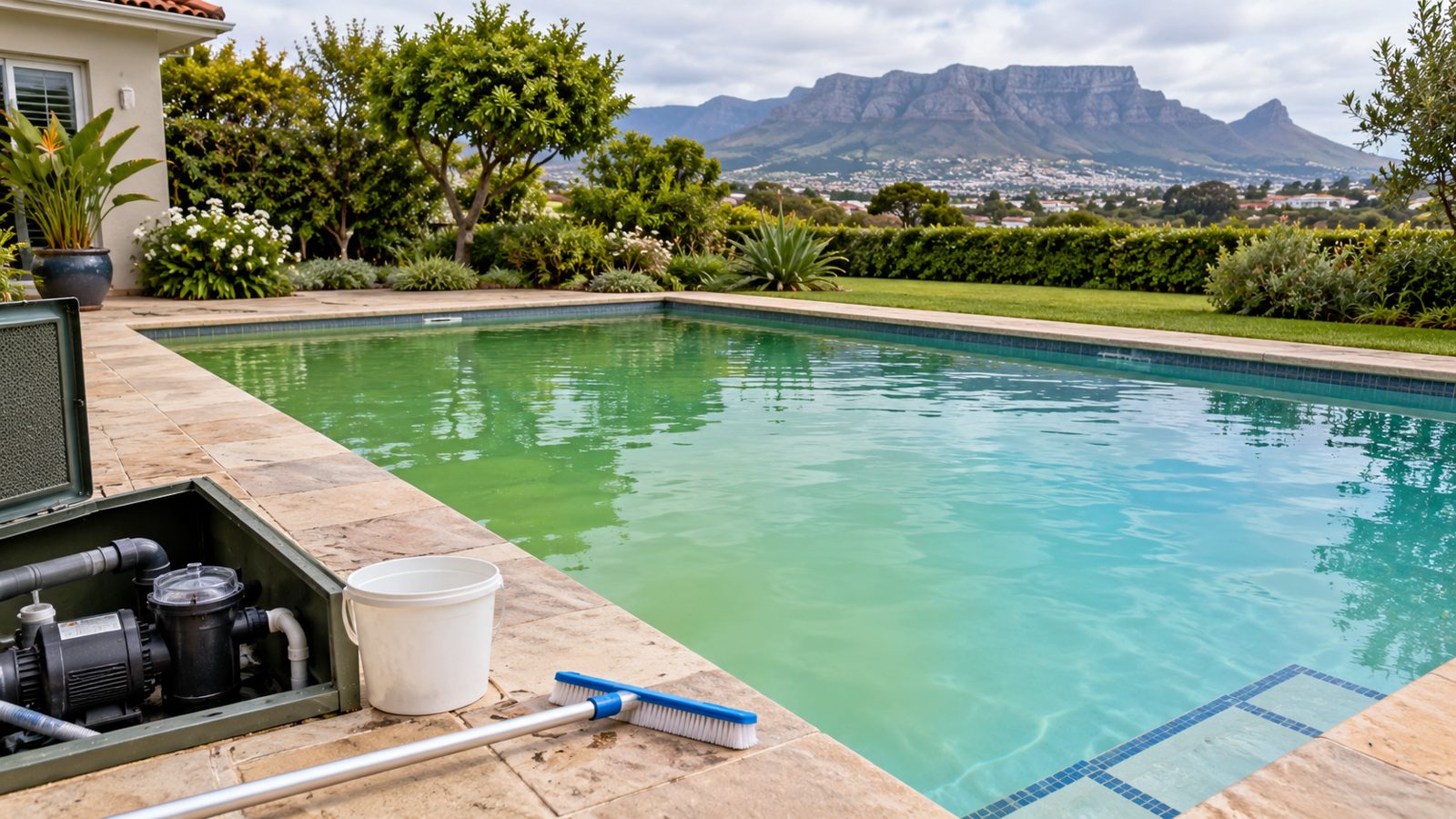
How much shock to add to a pool depends on three things: your litres, the strength of the chlorine and how bad the water looks. As a rule, raise free chlorine to about 10 ppm for routine or cloudy water, 20 ppm for a light green pool and 30 ppm for a dark green one. For a 50,000 litre pool going to 10 ppm, that’s about 770g of 65% granular chlorine or 3.3 litres of 15% liquid.
Shocking (also called super chlorination) is simply a much bigger chlorine dose than your daily top-up. It burns off the organic load, kills algae and clears the stale “chlorine” smell. The calculator below works out the dose, and the tables after it give the same answers if the form doesn’t load. If your pool has gone past green to swampy, our green pool recovery team can take over.
How much shock to add to a pool: pool shock calculator
Enter your pool size, choose the chlorine you have in the shed and pick the pool condition. The pool shock calculator sets a target (10, 20 or 30 ppm) that you can change, then gives grams of granular or millilitres of liquid. Put your current free chlorine reading in if you have one, because a pool already at 2 ppm needs a little less.
The maths behind it is short. Grams of available chlorine = litres x ppm rise / 1,000. Divide by the product strength (0.65 for 65% granular) to get grams of product. For liquid, divide the available chlorine by the strength times 10 and multiply by 1,000 to get millilitres. If you’re unsure of your volume, the pool volume calculator gets you there from length, width and average depth.
How much shock to add to a pool by size
These worked examples assume the free chlorine is at zero to start. Granular figures use 65% calcium hypochlorite and liquid figures use 15% sodium hypochlorite. Round to the nearest scoop or cup; you don’t need lab precision.
| Pool size | Routine or cloudy (10 ppm) | Light green (20 ppm) | Dark green (30 ppm) |
|---|---|---|---|
| 30,000 L | 460g or 2 L | 920g or 4 L | 1.4kg or 6 L |
| 50,000 L | 770g or 3.3 L | 1.5kg or 6.7 L | 2.3kg or 10 L |
| 80,000 L | 1.2kg or 5.3 L | 2.5kg or 10.7 L | 3.7kg or 16 L |
Household bleach is around 3.5% chlorine, so it takes a lot of it. A 50,000 litre pool going to 10 ppm needs roughly 14 litres of bleach, which is why most people use granular or pool-grade liquid instead. Use plain, unscented bleach only.
For everyday top-ups rather than shock doses, our guide on how much chlorine to add to a pool covers the normal 1 to 3 ppm range. At the time of writing (October 2026), SA shops list 10kg tubs of budget granular chlorine from around R499.99, so a full shock on a medium pool costs far less than a once-off clean. Ask our team for a current quote if you’d like us to do it.
When to shock a pool
You don’t need to shock on a fixed day of the week. Shock when the pool tells you it needs it, or after something that adds a lot of dirt or sweat in a short time. The usual triggers:
- After a pool party or a weekend with lots of swimmers.
- After a heatwave, when the sun burns chlorine off and the water warms up.
- After heavy rain, which dilutes the chlorine and washes in soil, leaves and fertiliser.
- When the water turns dull, cloudy or starts to smell strongly of “chlorine” (that’s actually chloramines).
- When you open the pool after leaving it covered or neglected for weeks.
- At the first hint of green on the walls or in the corners.
Cape Town has its own rhythm. Winter cold fronts can drop a lot of rain on a pool in a few days, diluting the chemicals and washing garden runoff in. Then the summer south-easter blows dust, pollen and leaves across the water for weeks at a time. Both push chlorine demand up, so a shock after a big storm or a long windy spell is cheap insurance.
Pool already green?
We test the water, shock it properly, brush and vacuum, and keep at it until the pool is clear. Tell us your pool size and how long it has been green.
Shock dose for green pool water
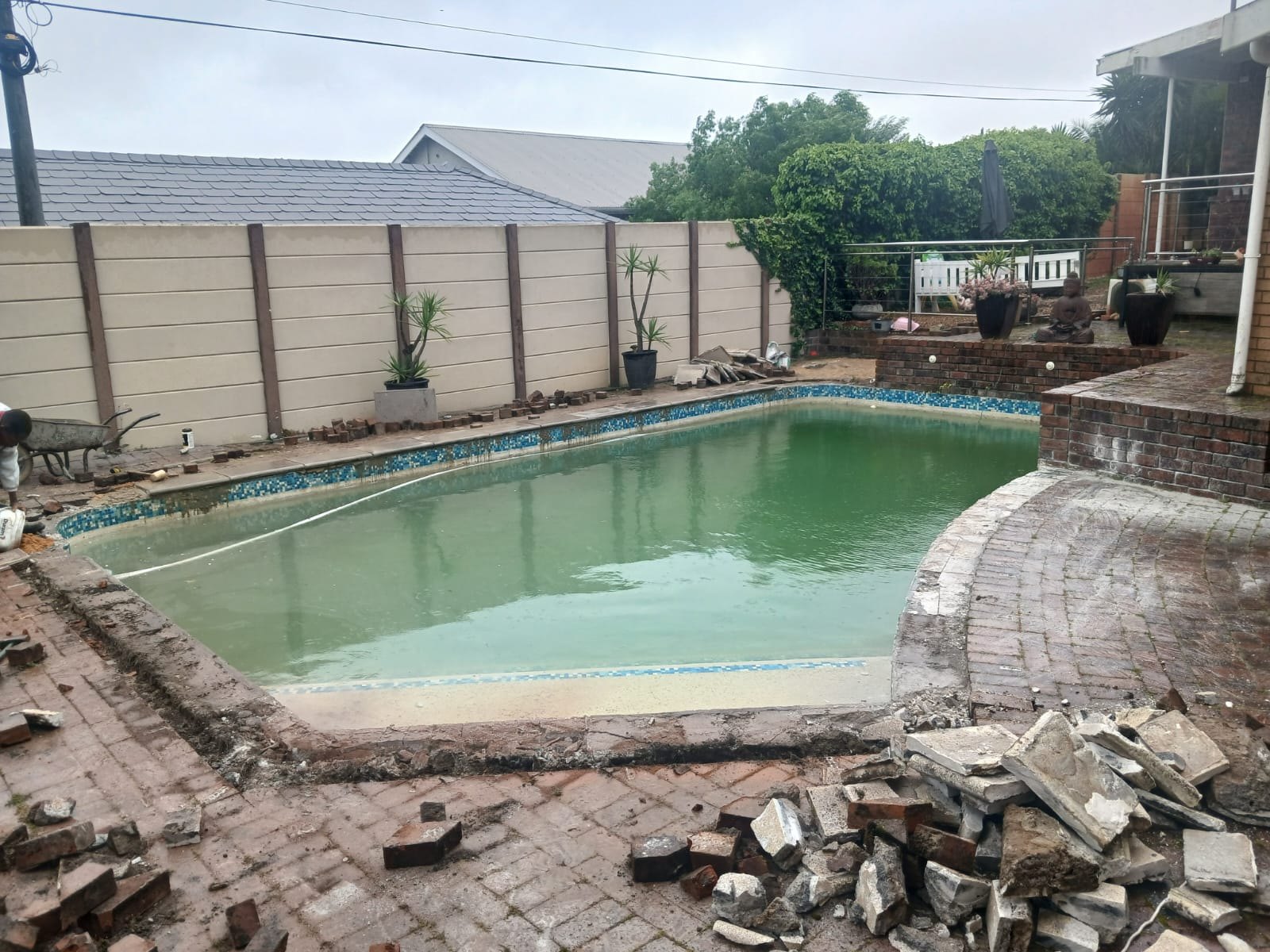
Green means algae, and algae needs more chlorine than a routine shock. The shock dose for green pool water depends on how deep the colour goes:
- Cloudy, faint green tint: 10 to 15 ppm usually does it, with brushing.
- Light green, floor still visible: aim for about 20 ppm.
- Dark green, floor not visible: start at about 30 ppm and expect to repeat it.
- Black, swampy or full of leaves: scoop out the debris first. Leaves soak up chlorine before it can reach the algae.
Stabiliser changes the numbers. Cyanuric acid protects chlorine from the sun, but it also slows it down, so the higher your stabiliser, the higher the shock target has to be. A common guide is a shock level of about 40% of the stabiliser reading. If you’ve been using stabilised chlorine for years, test it, and read our guide to pool stabiliser levels before you pour in bag after bag.
Keep the chlorine at shock level until the water clears, then let it drop. One dose often isn’t enough on a dark green pool. If it keeps turning green a week later, something else is wrong, and a green pool that keeps coming back walks through the usual causes.
Super chlorination starts with the pH
Check the pH before you shock. Chlorine works far better when the pH sits between 7.2 and 7.6. Above about 7.8, a big part of your dose is wasted, so you pay for chlorine that does very little. Get the pH into range first, and check total alkalinity while you’re at it, since it holds the pH steady.
If your readings jump around or you don’t trust your test strips, our water testing and balancing service gives you a full set of numbers. For low alkalinity, our baking soda dosing guide has the sums.
How to shock a pool, step by step
Work in the evening. The sun destroys unstabilised chlorine fast, so a dusk dose has the whole night to work.
- Test the free chlorine and pH, and correct the pH first if it’s high.
- Clean the skimmer and pump baskets, and backwash if the filter pressure is up.
- With the pump running, fill a clean plastic bucket with pool water.
- Add the granular chlorine to the water in the bucket (never water onto the chemical) and stir with a clean stick until it’s mostly dissolved.
- Pour it slowly around the deep end, away from the skimmer. Pour liquid chlorine straight in, close to the surface, in the same way.
- Brush the walls and floor so the chlorine reaches the algae.
- Leave the pump running for 24 hours, then test again.
Safety first: wear gloves and eye protection, follow the label and keep children and pets away while you dose. Add one product at a time and never mix chlorine with acid or with a different type of chlorine, even in an empty bucket. Store chlorine dry, closed and out of the sun.
After the shock: swimming, cloudiness and backwashing
Don’t swim until the free chlorine has dropped back to around 1 to 3 ppm. On a sunny day after an evening shock that may be the next afternoon. After a 30 ppm algae dose it can take a few days.
Dead algae turns the water grey or milky. That’s normal (see cloudy pool after shocking), and the filter clears it over a day or two as long as the pump runs. Backwash when the pressure gauge climbs well above its normal clean reading. If the water stays milky, read about a cloudy pool after shocking for the fixes. A once-off vacuum to waste also helps when dead algae settles on the floor.
How much shock to add to a pool: your questions
How much shock to add to a pool of 50,000 litres?
For a routine shock to 10 ppm, use about 770g of 65% granular chlorine or 3.3 litres of 15% liquid chlorine. A light green pool needs about double that, and a dark green pool about three times. Test first and subtract any chlorine already in the water.
How much liquid chlorine to shock a pool?
Allow about 67ml of 15% liquid chlorine per 1,000 litres for every 10 ppm rise. That’s 3.3 litres for a 50,000 litre pool at 10 ppm. Pour it slowly at the deep end with the pump running.
How much shock for a green pool?
Raise free chlorine to about 20 ppm for light green water and about 30 ppm for dark green, then brush and run the pump for 24 hours. Repeat if the chlorine drops to zero before the water clears. High stabiliser means you’ll need an even higher target.
How often should you shock a pool?
Shock when the water looks dull or cloudy, after heavy use, after a big storm or at the first sign of algae. In Cape Town that often means after winter cold fronts and during long south-easter spells. A well-kept pool may only need it every few weeks.
Can I swim after shocking the pool?
Wait until free chlorine is back down to about 1 to 3 ppm. After an evening shock to 10 ppm that’s usually the next day. Test before anyone gets in, especially children.
If you’d rather not handle the chemicals yourself, our green pool clean-up service brings a green pool back to clear, and regular pool water balancing keeps it there.
Want the water sorted for you?
We test, dose, brush and backwash, then tell you what caused the problem. Send us your pool size and a photo of the water.


