


What size pool pump do I need? For most South African home pools the answer is a 0.55kW to 1.1kW pump: roughly 0.55kW up to about 45,000 litres, 0.75kW for 50,000 to 70,000 litres and 1.1kW for bigger pools, based on turning the water over once in about eight hours. The calculator below does the sum for your pool and suggests a matching sand filter.
Bigger isn’t better. A pump that’s too strong for the filter and pipes wastes power, pushes dirt through the sand and wears seals faster. If your current pump is noisy, tripping or leaking, it may be a repair rather than a sizing problem, and our pool pump repairs team can tell you which.
What size pool pump do I need? Pool pump size calculator
Type in your pool’s litres and the number of hours you want for one full turnover. Eight hours is the usual setting for a home pool. The calculator gives the flow you need in cubic metres per hour, a suggested pool pump kW rating and the matching sand filter size.
Here’s the sum it uses: flow (m3/h) = litres / 1,000 / turnover hours. A 50,000 litre pool on an eight hour turnover needs about 6.3 m3/h. The flow then maps to a motor band: up to 6 m3/h is 0.55kW, up to 9 is 0.75kW, up to 13 is 1.1kW and up to 17 is 1.5kW. If you don’t know your litres, start with our pool volume calculator.
What size pool pump do I need for my litres?
These worked examples use an eight hour turnover. They line up with the way local suppliers pair pumps and filters, but they’re a starting point. Long pipe runs, a heat pump or solar panels in the loop all add resistance, and your installer may go one size up for those.
| Pool volume | Flow needed | Suggested pump | Sand filter |
|---|---|---|---|
| 20,000 L | 2.5 m3/h | 0.55kW | 2 bag |
| 30,000 L | 3.8 m3/h | 0.55kW | 2 bag |
| 40,000 L | 5 m3/h | 0.55kW | 2 bag |
| 50,000 L | 6.3 m3/h | 0.75kW | 3 bag |
| 60,000 L | 7.5 m3/h | 0.75kW | 4 bag |
| 80,000 L | 10 m3/h | 1.1kW | 4 bag |
| 100,000 L | 12.5 m3/h | 1.1kW | 5 bag |
So what size pump for a 50,000 litre pool? A 0.75kW pump with a 3 bag sand filter covers it comfortably. The filter matters as much as the motor: a big pump on a small filter means high pressure and short runs between backwashes. Our guide on how much sand a pool filter takes lists the bag ratings.
Turnover rate: how fast the water should go round
The turnover rate is the time your pump takes to push the full volume of the pool through the filter once. Most home pools are set up for one turnover in six to eight hours. A shorter turnover needs a bigger pump; a longer one lets you use a smaller pump for more hours.
One local supplier’s rule of thumb is one full turnover a day in winter and two in summer. That’s why summer run times are roughly double the winter ones. In Cape Town the summer south-easter blows dust and leaves in for weeks, so pools that catch the wind often need the longer summer setting.
Pool size, swimmers and debris all change how much filtering you need. A shaded plunge pool used twice a week is very different to a family pool next to a pine tree. Run the pump long enough to keep the water clear and the chlorine steady, and no longer.
Not sure your pump is the right size?
Send us a photo of the pump label and filter, plus your pool size. We will tell you if the pump, the filter or the plumbing is holding you back.
Pool pump size: why bigger is not better
It’s tempting to buy the biggest pump the budget allows. In practice an oversized pump causes more trouble than it solves:
- Higher power bills: a 1.5kW motor running eight hours uses twice the power of a 0.75kW motor over the same time.
- Fights the filter: water rushes through the sand too fast, so fine dirt slips through and the pressure climbs.
- Pipe limits: home pool plumbing can only carry so much water. A bigger pump on the same pipes mostly adds noise and pressure, not flow.
- Wear and tear: high pressure stresses the multiport valve, O-rings and mechanical seal.
- Cavitation: if the suction side can’t keep up, the pump starves of water, gets loud and can lose prime.
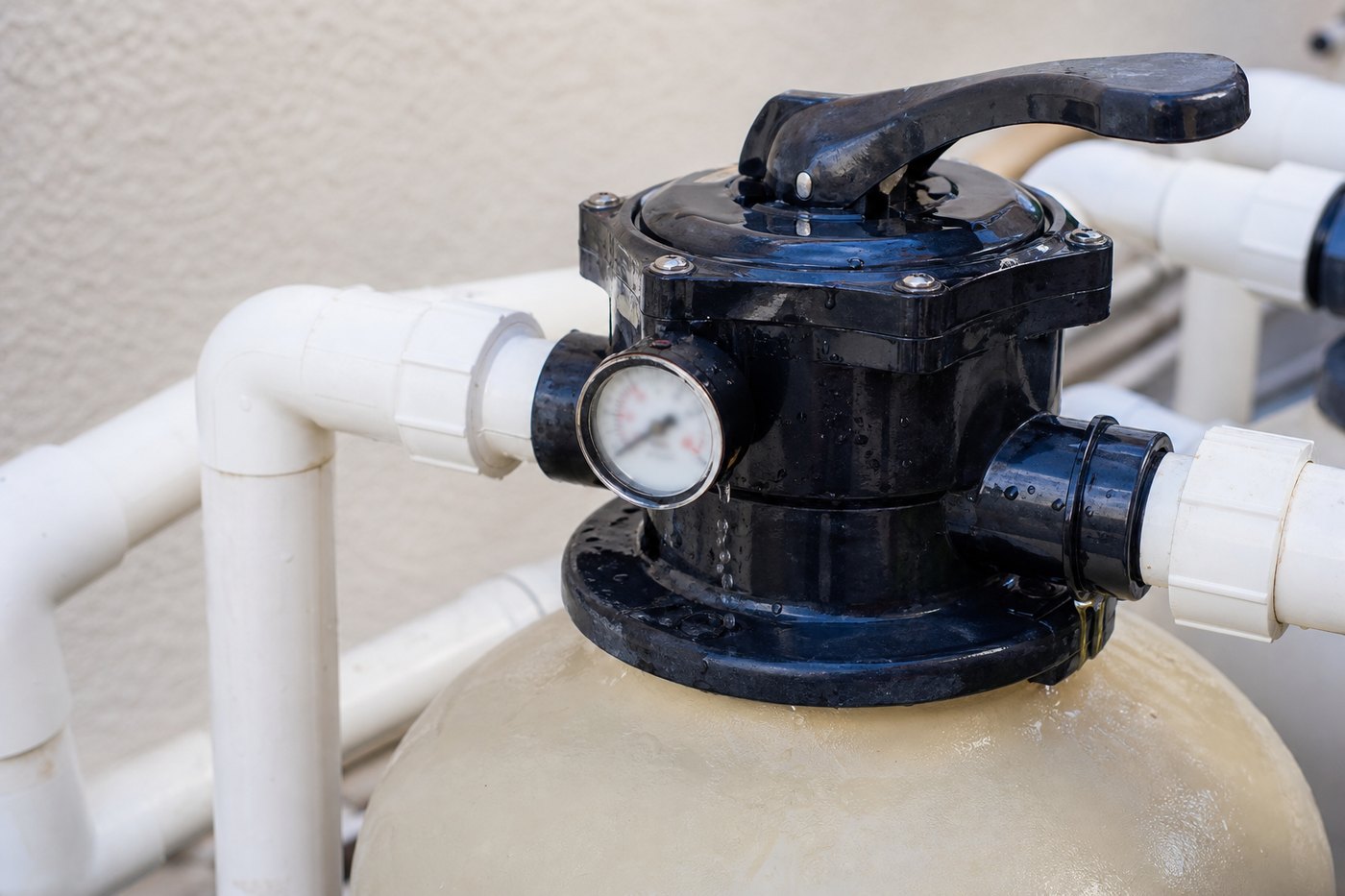
If your gauge sits high even after a backwash, read our guide on pool filter pressure that is too high. An undersized pump has the opposite problem: weak returns, a skimmer that barely pulls and water that never quite clears.
Variable speed pool pump: is it worth it?
A variable speed pool pump lets you run slowly for most of the day and speed up only for backwashing, vacuuming or a heater. The physics is on your side here. Pump affinity laws mean power draw drops with the cube of the speed, so halving the speed cuts the power to roughly one eighth while still moving half the water.
At the time of writing (October 2026), SA shops list 0.75kW variable speed pumps from around R9,725 (excl VAT), against about R2,390 for a basic single-speed 0.75kW pump. They also run quieter. The payback depends on your hours and your tariff. With Cape Town Home User electricity at R3.56 per kWh in the first block, a single-speed 0.75kW pump running eight hours a day uses about 6kWh, or roughly R640 a month.
A slow-running pump does need the right timer settings and enough flow at low speed for a salt chlorinator or solar heating to work. Our pool automation and timers team sets the speeds and run times so you don’t lose the savings.
Signs your pool pump is the wrong size
Most pumps are replaced like for like, so a wrong size can sit there for years. Here’s how to check yours without opening anything:
- Read the motor label for the kW rating and compare it with the chart above.
- Check the filter label for its bag rating or maximum flow.
- Note the gauge reading straight after a backwash. A very high clean reading suggests the pump is too strong for the filter.
- Feel the flow at the return jets and watch the skimmer flap. Weak flow with clean baskets points to a small or tired pump.
- Listen for a gravelly, rattling sound from the pump. That’s often the pump starving for water.
Quick photo check: take a clear picture of the pump motor label and the filter label and send them to our team with your pool size. That alone usually tells us whether the pump, the filter or the plumbing is the weak link.
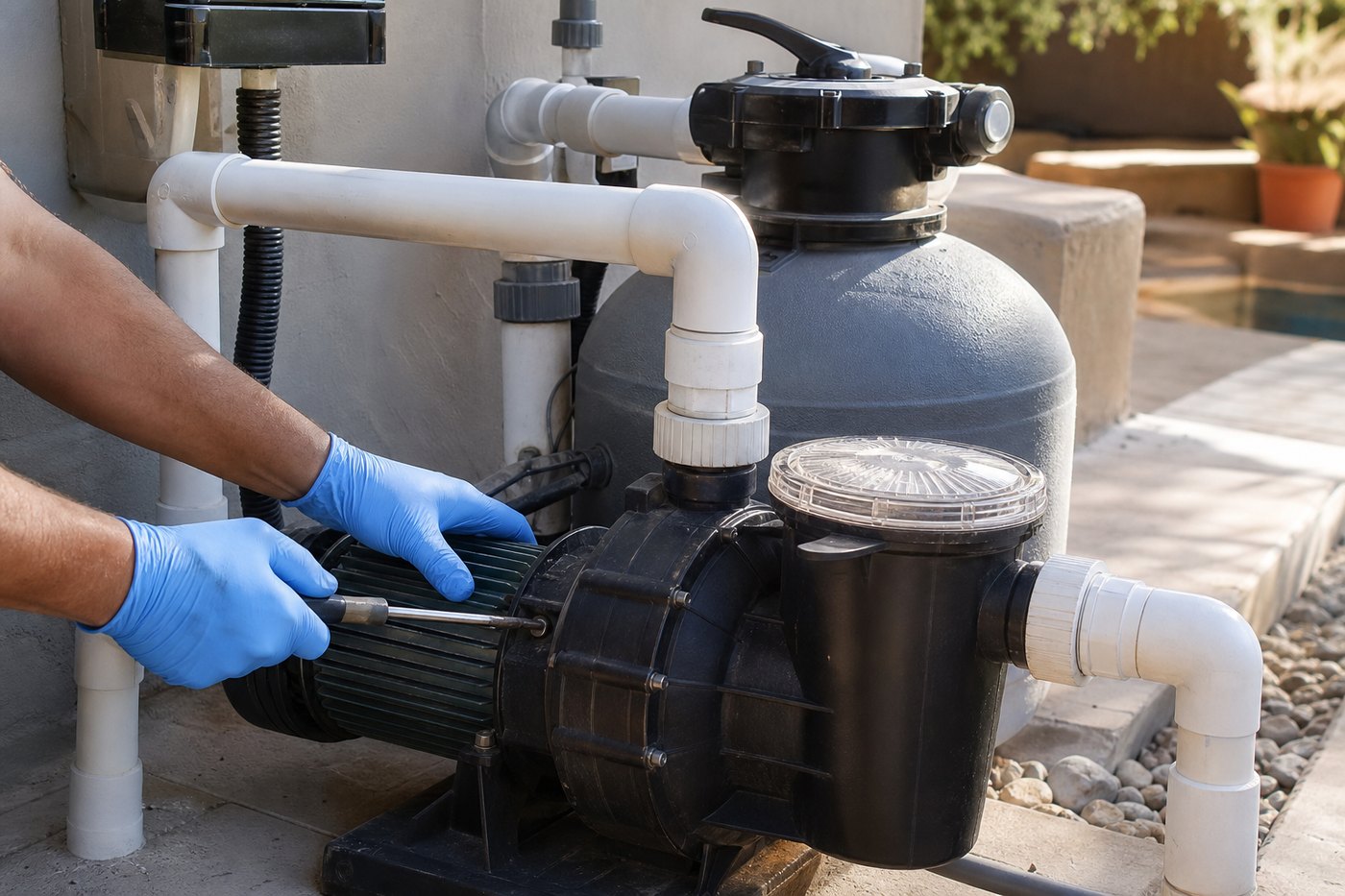
Leave anything electrical to a qualified electrician, and don’t open the motor or the capacitor cover. A pump that hums, trips or runs hot is a repair job. Our guides to a noisy pool pump and a pump that keeps losing prime cover the usual causes.
Pool pump kW and price
At the time of writing (October 2026), SA shops list single-speed pumps from around R2,150 for a 0.25kW unit, R2,390 for 0.75kW, R2,830 for 1.1kW and R3,390 for 1.5kW. Installation labour starts from around R1,350 in Cape Town. Coastal salt air corrodes motors and clamps, so suburbs close to the sea often see pumps replaced sooner. Our pool pump prices guide breaks this down further, and ask our team for a current quote.
Before you buy, check whether a repair makes more sense. Seals and bearings are far cheaper than a new motor, and the pool pump repair cost guide shows when repairing beats replacing.
What size pool pump do I need: common questions
What size pool pump do I need for a 50,000 litre pool?
A 0.75kW pump with a 3 bag sand filter suits most 50,000 litre pools on an eight hour turnover. That moves about 6.3 cubic metres an hour. Go up a size only if the pump also feeds solar panels, a heat pump or a long pipe run.
What size pump for a 30,000 litre pool?
A 0.55kW pump with a 2 bag filter is enough for most 30,000 litre pools. It needs only about 3.8 cubic metres an hour to turn the water over in eight hours.
Is a bigger pool pump better?
No. An oversized pump pushes water through the filter too fast, raises the pressure and uses more electricity. Match the pump to your litres, filter and pipe size instead.
How long should I run my pool pump?
Long enough for one full turnover in winter and about two in summer. For a correctly sized pump that’s roughly four hours in winter and eight in summer, more if the pool catches lots of leaves or dust.
Is a variable speed pool pump worth it in South Africa?
It can be if your pump runs many hours a day. Running slower cuts power use sharply, though the pump costs more upfront. The payback depends on your hours and electricity tariff.
If your pump is struggling, our pump repair service checks the motor, seals and flow before anyone talks about replacing it.
Get your pump sized and checked
We look at your pool size, filter, pipes and running hours, then recommend a repair or the right replacement. Ask for a quote.


