

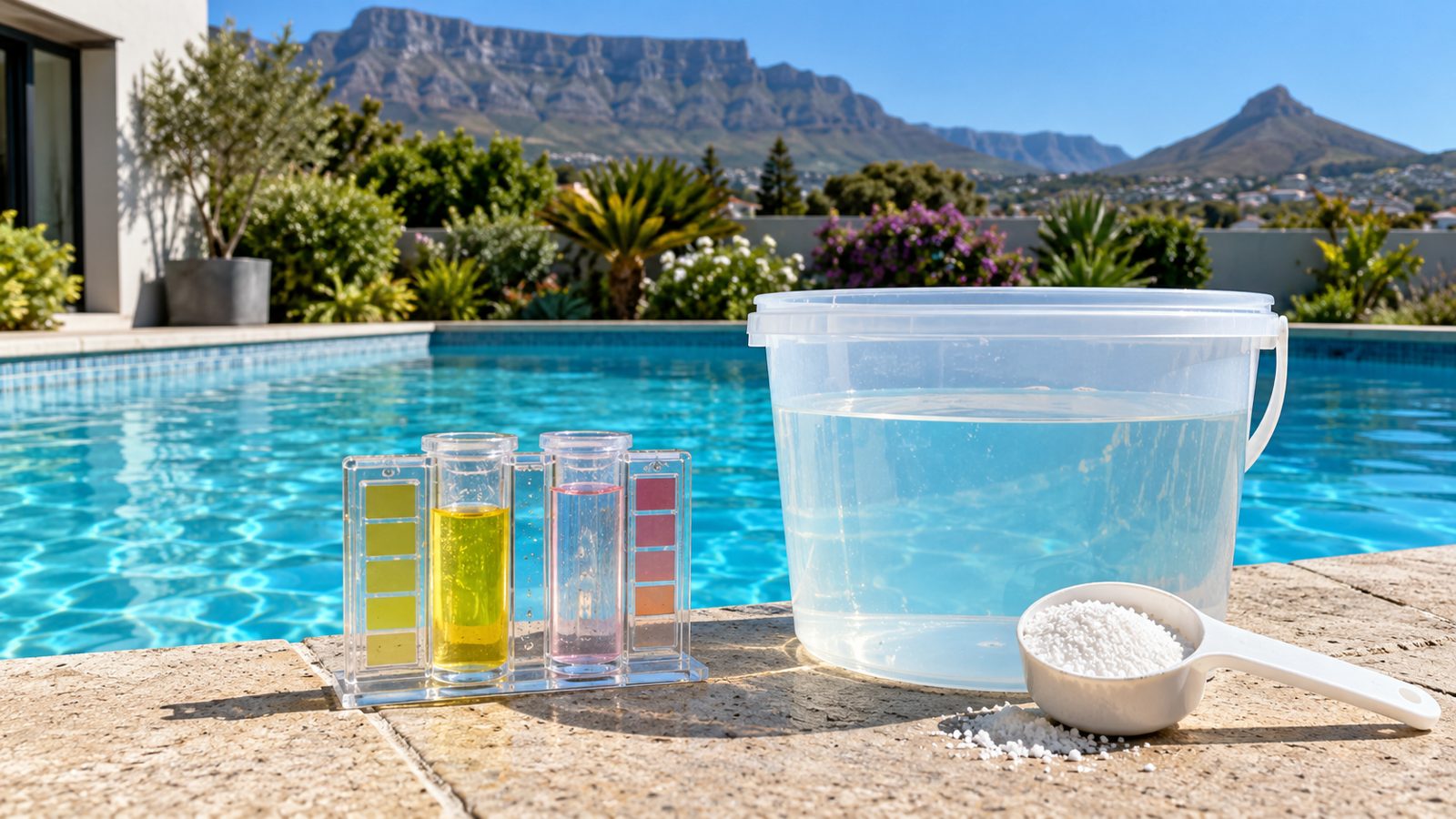
How much chlorine to add to a pool depends on your litres, the strength of your chlorine and how far your free chlorine has dropped. As a rule, each 1 ppm rise needs 1g of available chlorine per 1,000 litres, so a 50,000 litre pool going up by 2.5 ppm needs about 192g of 65% granular or 833ml of 15% liquid.
That’s a routine top-up, not a shock. The aim is to keep free chlorine steady between 1 and 3 ppm, day in and day out. Test first, then dose. If you’d rather leave the testing to us, our pool water testing and balancing service sets every reading at once.
How much chlorine to add to a pool: pool chlorine calculator
Choose your product, enter your pool size, your current free chlorine reading and your target. The pool chlorine calculator shows the grams of granular or the millilitres of liquid. Read the strength on the container, because brands differ.
If you’re unsure of the volume, use our pool volume calculator first. Guessing the litres is where most dosing mistakes start.
Worked examples: how much chlorine to add to a pool by size
The maths behind the calculator is short. Grams of available chlorine = litres x ppm rise / 1,000. Divide by the product strength to get the grams of granular. For liquid, millilitres = grams of chlorine / (strength x 10) x 1,000.
| Pool size | 65% granular | 70% granular | 15% liquid | 3.5% bleach |
|---|---|---|---|---|
| 5,000 L | 19g | 18g | 83ml | 357ml |
| 20,000 L | 77g | 71g | 333ml | 1.4 L |
| 30,000 L | 115g | 107g | 500ml | 2.1 L |
| 50,000 L | 192g | 179g | 833ml | 3.6 L |
| 70,000 L | 269g | 250g | 1.17 L | 5 L |
Need a bigger or smaller rise? Scale it. A 1 ppm lift is 40% of the figures above, and a 1.5 ppm lift is 60%. For a 50,000 litre pool that reads 2 ppm and needs to reach 3 ppm, that’s about 77g of 65% granular.
Free chlorine level: how much chlorine to add to a pool to stay in range
Free chlorine is the part that’s still available to kill germs and algae. Health guidance for pools says to keep it at least 1 ppm, and most pool guides suggest 1 to 3 ppm for home pools. Below 1 ppm, algae can take hold within days in warm weather.
- Under 1 ppm: dose now. The water may still look clear, but it isn’t protected.
- 1 to 3 ppm: the working range. Top up as the reading drops.
- Over 5 ppm: skip the next dose and let the sun bring it down before swimming.
Use a DPD test kit or good test strips, and test in the evening before you dose. Free chlorine only works properly when pH sits between about 7.2 and 7.6, so check pH at the same time. If the water keeps turning green even with chlorine in it, read why a green pool keeps coming back.

Granular chlorine dose: getting it right
Granular chlorine (calcium hypochlorite) is the most common choice in South Africa. Most brands sit around 65 to 70% available chlorine. At the time of writing (October 2026), SA shops list an 8kg tub from around R479 and budget 10kg buckets from around R499.99.
A granular chlorine dose should always be weighed. A level kitchen scoop holds very different amounts depending on the product. Pre-dissolve the granules in a bucket of pool water, then pour it slowly in front of a return jet. This matters most on fibreglass and painted pools, where undissolved granules sitting on the floor can bleach or mark the surface.
Unstabilised granular adds calcium to the water over time. Stabilised products (often called dichlor or trichlor) add stabiliser with every dose instead. Neither is a problem if you test, but it explains why readings drift on long-term single-product routines.
Want someone to keep your chlorine in range?
Our team tests and doses on every service visit, so your pool stays clear without you weighing granules every second day. Tell us your pool size and suburb.
Liquid chlorine dose: strength matters
Liquid chlorine is sodium hypochlorite. Pool-grade liquid is usually 12 to 15%, and plain household bleach is about 3.5%. A liquid chlorine dose works fast because there’s nothing to dissolve, and it adds no calcium or stabiliser.
The catch is strength loss. Liquid chlorine weakens in storage, faster in heat and sunlight. A container that has stood in a hot garage all summer may be well under its label strength, so you’ll need more than the calculator says. Buy what you’ll use within a few weeks and keep it in a cool, shaded place.
Pour liquid chlorine low, close to the water and in front of a return, so it doesn’t splash. Never use scented, “thick” or splash-less bleach, because the additives foam and cloud the water.
Why chlorine disappears so fast in summer
Sunlight is the biggest chlorine thief. UV breaks down unprotected chlorine within hours, which is why a pool can read 3 ppm at night and close to zero by the next afternoon. Stabiliser (cyanuric acid) shields it from the sun, so if your chlorine vanishes every day, test the stabiliser level next.
Other things that use chlorine up:
- Heavy swimming, sunscreen and sweat on hot days.
- Leaves and dust, especially when the summer south-easter blows debris in. See our tips on wind-blown debris in the pool.
- Winter rain, which dilutes the water and washes garden soil in.
- Short pump hours, which leave dead spots where algae can start.
Running a salt pool? The chlorinator makes the chlorine for you (if readings stay low, see salt chlorinator not producing chlorine), but the free chlorine target is the same. Our guide on how much salt to add to a pool covers that side.
How to add chlorine safely
Pool chlorine is a strong oxidiser. Treat it with respect and the job takes five minutes.
- Test free chlorine and pH. Work out the dose with the calculator.
- Switch the pump on and leave it running.
- Wear gloves and eye protection. Keep children and pets away.
- For granular, fill a clean plastic bucket with pool water first, then add the chlorine to the water. Never add water to chlorine.
- Stir with a plastic stick until dissolved, then pour slowly in front of a return jet.
- Rinse the bucket and never use it for any other pool product. One product at a time, and never mix chemicals.
- Dose at dusk so the sun doesn’t burn it off, and retest the next morning.
Most people find a written routine helps. Our weekly pool maintenance checklist puts testing, dosing and cleaning in order.
Store it apart. Keep chlorine dry, closed and away from acid and other pool products. A spill of chlorine near acid can release toxic gas.
Chlorine dosing questions
How much chlorine to add to a pool of 50,000 litres?
To lift free chlorine by 2.5 ppm in a 50,000 litre pool, add about 192g of 65% granular chlorine or about 833ml of 15% liquid chlorine. For a smaller rise, scale it down: 1 ppm takes roughly 77g of granular in the same pool.
How much chlorine for a 5,000 litre pool?
A 5,000 litre pool needs only about 8g of 65% granular chlorine to raise free chlorine by 1 ppm, or about 33ml of 15% liquid. Small pools are easy to overdose, so weigh the granules instead of guessing with a scoop.
What should the free chlorine level be in a pool?
Keep free chlorine between 1 and 3 ppm for a home pool, and never let it drop below 1 ppm. In a hot Cape Town summer with heavy swimming, aim for the top of that range.
Can I use household bleach instead of pool chlorine?
You can, but plain household bleach is only about 3.5% chlorine, so you need a lot of it: roughly 3.6 litres to lift a 50,000 litre pool by 2.5 ppm. Use only plain, unscented bleach and never mix it with any other product.
How often should I add chlorine to my pool?
Test two or three times a week in summer and dose to bring free chlorine back into range. Most Cape Town pools need a top-up every one to three days in summer and less often in winter, when the sun is weaker.
If you’d rather not test and dose every few days, our pool maintenance visits include it, and we can do a once-off water balance check if the readings don’t make sense.
Get your pool water tested
Chlorine that won’t hold, or water that’s clear one day and dull the next? We’ll test everything, balance it and explain what’s going on.


