


How much baking soda to add to a pool is easy to work out: about 168g per 10,000 litres raises total alkalinity by 10 ppm. A 50,000 litre pool sitting at 60 ppm needs about 3.36kg to reach 100 ppm, ideally added in two or three goes rather than all at once.
Baking soda (sodium bicarbonate) is the standard way to raise alkalinity in pool water, and it’s the same chemical in most branded “alkalinity up” tubs. The calculator below does the maths, and the tables give you a fallback. If your readings keep swinging, our pool water testing and balancing team can find out why.
How much baking soda to add to a pool: pool alkalinity calculator
Enter your litres, your total alkalinity reading and your target. The pool alkalinity calculator returns the grams of sodium bicarbonate to add. Most people set the target at 100 ppm, which sits in the middle of the ideal range.
If the litres are a guess, check them with our pool volume calculator. A 20% error in volume means a 20% error in the dose.
How much baking soda to add to a pool by size
The formula is grams = litres x ppm rise x 1.68 / 1,000. So every 1,000 litres needs 1.68g for each 1 ppm. The worked examples below are rounded to the nearest 10g.
| Pool size | +10 ppm | +20 ppm | +40 ppm (60 to 100) |
|---|---|---|---|
| 10,000 L | 170g | 340g | 670g |
| 20,000 L | 340g | 670g | 1.34kg |
| 30,000 L | 500g | 1.01kg | 2.02kg |
| 50,000 L | 840g | 1.68kg | 3.36kg |
| 70,000 L | 1.18kg | 2.35kg | 4.70kg |
Example: your 40,000 litre pool reads 70 ppm and you want 100 ppm. That’s a 30 ppm rise, so 40,000 x 30 x 1.68 / 1,000 = 2,016g. Add about 1kg, circulate for six hours, retest, then add the rest if the reading still needs it.
Total alkalinity: why it decides how much baking soda to add to a pool
Total alkalinity is the water’s pH buffer. It soaks up acids and bases so the pH doesn’t jump around every time it rains or you add chlorine. The widely used target is 80 to 120 ppm.
- Below 80 ppm: pH bounces, often down, after rain or acid. Low pH water can etch plaster and corrode metal.
- 80 to 120 ppm: pH holds steady and chlorine works as it should.
- Above 120 ppm: pH tends to creep up, and the water can go cloudy or leave scale on the waterline tiles.
Always balance alkalinity before you fine-tune pH. If you correct pH first and the buffer is low, it simply drifts back. Test both together with a decent kit and note the readings so you can see trends.
Test strips are fine for a quick look, but a drop-count kit gives a far more precise total alkalinity reading. If two methods disagree by more than 20 ppm, take a sample to a pool shop before dosing a few kilograms on a guess. Our weekly pool maintenance checklist shows where alkalinity fits in a normal testing routine.
Alkalinity also moves slowly compared to chlorine. A healthy pool may only need a correction a few times a year, so if you find yourself adding bicarb every week, something else is going on. Look for leaks, constant top-ups, or heavy acid use first.
Baking soda vs alkalinity increaser
Read the back of a branded alkalinity increaser and you’ll usually see one ingredient: sodium bicarbonate. That’s baking soda. Pool chemical makers say as much themselves, so use whichever you can buy in bulk at a fair price. The dose is identical.
Two products are often confused with it:
- Soda ash (sodium carbonate): sold as pH increaser. It raises pH much more sharply than bicarb and only lifts alkalinity a little.
- “Buffer” blends: some combine bicarbonate with other salts. Follow the label dose for those, not this calculator.
Food-grade bicarb from a bulk or baking supplier works fine in a pool. Just make sure it’s plain sodium bicarbonate with nothing added.
Readings all over the place?
If alkalinity, pH and chlorine won’t settle, our team will test the full set, balance the water and tell you what’s pulling it off. Send us your pool size and suburb.
How to raise alkalinity in pool water, step by step
Baking soda is mild and safe to handle, but follow the same habits you use for every pool product.
- Test total alkalinity and pH. Work out the dose with the calculator.
- Run the pump. Keep it running for the whole process.
- Split anything over about 20 ppm into two or three doses.
- Broadcast the powder across the deep end, or pre-dissolve it in a bucket of pool water first (add the bicarb to the water, never the other way round).
- Brush any powder that settles on the floor.
- Wait about six hours, then retest before adding more.
- Once alkalinity is in range, check pH and adjust that last.
Keep children and pets away while you dose, and don’t add any other chemical on the same pass. Our pool chlorine calculator covers the chlorine step once the balance is right.
Overshot it? High alkalinity is harder to bring down than low alkalinity is to raise. It takes careful acid dosing over several days. That’s why the split-dose habit is worth the wait.
Why Cape Town pools drift low in winter
Cape Town’s municipal water is soft, and rainwater is softer still with almost no alkalinity. Every winter storm that tops up or overflows your pool dilutes the buffer. It’s common to start the season at 100 ppm and find 60 ppm by August.
Acid dosing also lowers total alkalinity a little each time. Salt pools tend to push pH up, so their owners add acid more often, which slowly drags alkalinity down too. If that sounds familiar, test monthly through winter rather than waiting for spring. A pool that’s overflowed after heavy rain should be tested within a day or two.
Summer brings the opposite pattern in some pools. Evaporation concentrates what’s left, while fresh top-up water dilutes it again, so readings can wander either way. The fix is the same: test, then dose only what the numbers say.
The other common cause is a leak. Fresh top-up water keeps going in and the chemistry never settles. If you’re adding water every week and you don’t know why, rule that out first.
Low total alkalinity and your pool surface
Water that’s low in alkalinity and pH is aggressive. It pulls calcium out of cement-based finishes like marbelite and plaster. The first signs are a rough, sandpaper feel underfoot, then a blotchy, washed-out look and exposed grains.
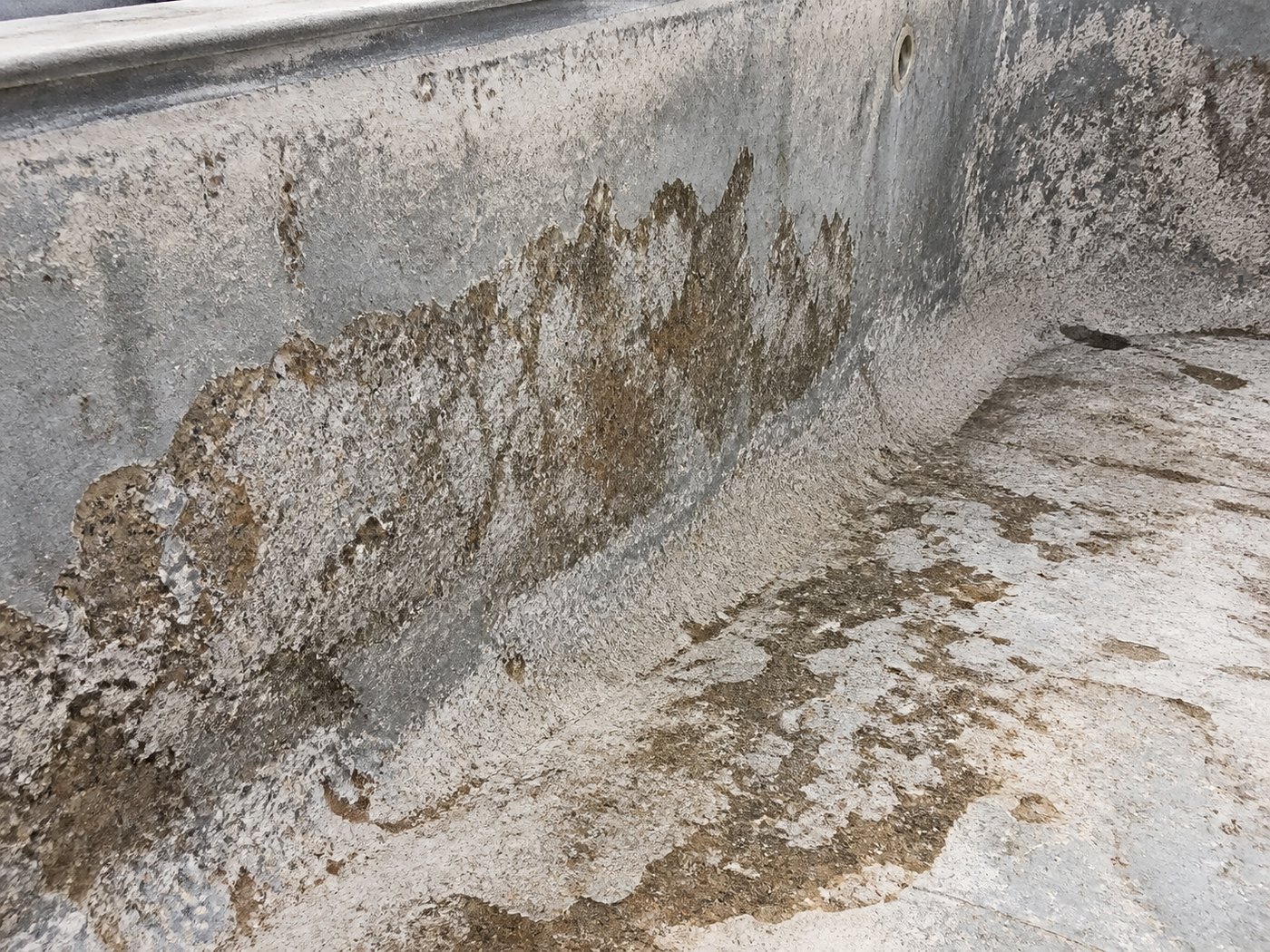
Older marbelite pools in Cape Town are especially exposed, because the finish is already thin. If your pool feels gritty, read our guide to a rough pool surface. Fine crazing can be a related sign, covered in our article on hairline cracks in pool plaster.
Balanced water won’t repair damage already done, but it stops it getting worse. When the surface has gone too far, marbelite resurfacing is the long-term fix.
Alkalinity questions
How much baking soda to add to a pool to raise alkalinity by 10 ppm?
Use about 168g of baking soda per 10,000 litres for every 10 ppm. A 50,000 litre pool needs about 840g to go up 10 ppm, and about 3.36kg to go up 40 ppm.
What should my pool alkalinity be?
Keep total alkalinity between 80 and 120 ppm. Plaster and marbelite pools are happiest in the upper half of that range, because the extra buffer protects the surface.
How much alkalinity increaser to add to a pool at one time?
Most pool guides suggest adding no more than about 10 to 20 ppm worth at a time, then retesting after about six hours of circulation. For a 50,000 litre pool, that’s roughly 0.85 to 1.7kg per dose.
Is baking soda the same as alkalinity increaser?
In most cases, yes. Branded alkalinity increasers are usually sodium bicarbonate, the same chemical as baking soda. Check the label: if it says sodium bicarbonate, the dose is the same.
Will baking soda raise the pH in my pool?
A little. Baking soda mainly lifts total alkalinity and only nudges pH up slightly. If pH is low but alkalinity is already in range, you need a pH increaser (soda ash) instead, so test both before you dose.
Want the testing taken off your hands? Our pool maintenance visits include alkalinity checks, or book a once-off pool water balancing visit.
Book a water balance check
We’ll test alkalinity, pH, chlorine, stabiliser and salt, then dose and explain each reading. You’ll get a quote before any extra work.


