

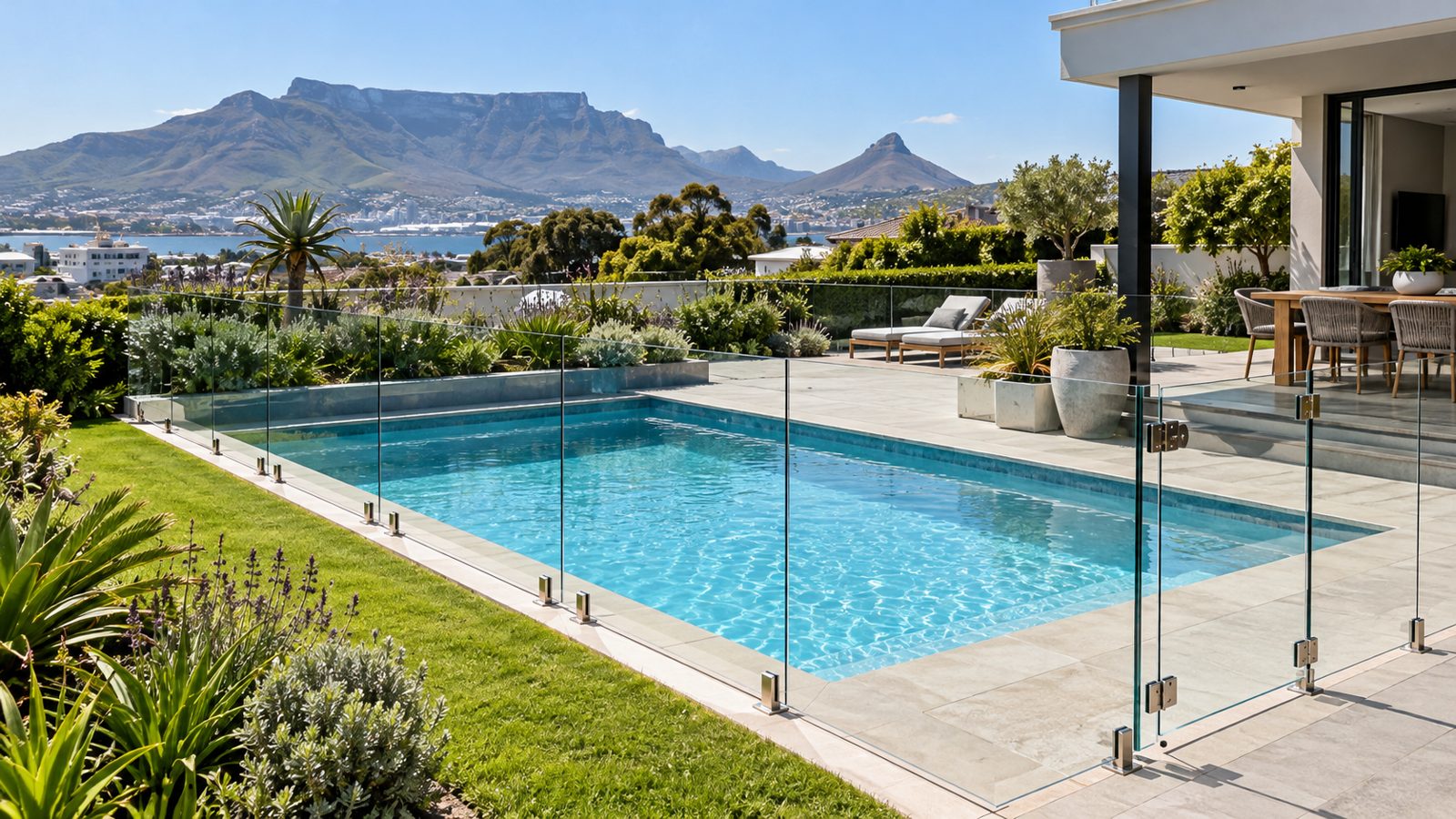
Pool fencing comes in four main types in South Africa: frameless or semi-frameless glass, powder-coated aluminium or steel, removable mesh, and palisade or clear-view style steel. Whichever you choose, the barrier should be at least 1.2m high, hard to climb and fitted with a self-closing, self-latching gate.
The right choice depends on your budget, how close you live to the sea and whether you want the fence there permanently. Below we compare the options side by side, explain the safety rules in plain language and cover what each type costs. To have a barrier assessed or installed, see our pool safety nets and fencing service.
Pool fencing options compared
Here’s how the main types of pool fence stack up. Prices are per metre installed, from SA suppliers at the time of writing (October 2026), and vary with height, ground conditions and the number of gates.
| Type | Typical price per metre | Look | Best for |
|---|---|---|---|
| Removable mesh | From around R300 to R600 | See-through, soft | Families with toddlers, rentals, tight budgets |
| Powder-coated aluminium | From around R800 to R1,500 | Slim vertical bars | Coastal homes, low maintenance |
| Clear-view style steel mesh | From around R1,000 to R1,300 | Fine welded mesh | Security plus safety, large perimeters |
| Frameless or semi-frameless glass | From around R2,000 to R3,500 | Almost invisible | Views, modern homes, resale appeal |
Multiply the per metre figure by the length of fence you need, not the pool’s perimeter. Using an existing boundary wall or the side of the house as part of the barrier can shorten the run a lot, as long as no doors or windows open straight into the pool area.
Glass pool fencing
Glass pool fencing is the premium choice. Frameless glass uses thick toughened safety glass panels held by stainless steel spigots or clamps, with no top rail. Semi-frameless adds slim posts or a rail and costs a bit less.
- Pros: clear views of the water and garden, nothing to climb, easy to keep an eye on swimmers from the house, and it suits modern homes.
- Cons: the most expensive option, glass shows salt spray, water spots and fingerprints, and it needs a solid concrete or paving base for the spigots.
- Watch for: the gap at the bottom of each panel and between panels, which must stay small enough that a child can’t squeeze through.
The spigots are core-drilled into concrete or set into the paving, so plan the fence before you redo the surround. If new pool paving and coping is on the cards, fit the fence fixings at the same time.
On the coast, the fittings matter more than the glass. Use 316 grade stainless steel spigots, hinges and latches. Lower grades like 304 tend to rust and tea-stain in salt air, sometimes within a season or two.
Aluminium and steel pool fencing
Powder-coated aluminium is the workhorse of pool fencing. It’s light, doesn’t rust and comes in standard heights and colours. Steel versions are stronger and often cheaper upfront, but rely on the galvanising and powder coat to keep rust away.
The key design rule is vertical bars with no horizontal rails a child could use as a ladder. Many boundary-style fences and balustrades have a mid rail or decorative horizontals that make them easy to climb, so they don’t make a good pool safety fence even if they look sturdy.
Palisade fencing is common in South Africa but its gaps are often too wide for a pool barrier and its rails are climbable. Clear-view style welded mesh solves both problems, with apertures far too small for fingers or toes.
Check what’s next to the fence. A braai, a pot plant, a pool pump box or a low wall within reach of the outside of the fence turns a 1.2m barrier into a step. Keep a clear zone around it, and don’t forget the pool decking area if a raised deck sits against the fence.
Removable mesh pool fencing
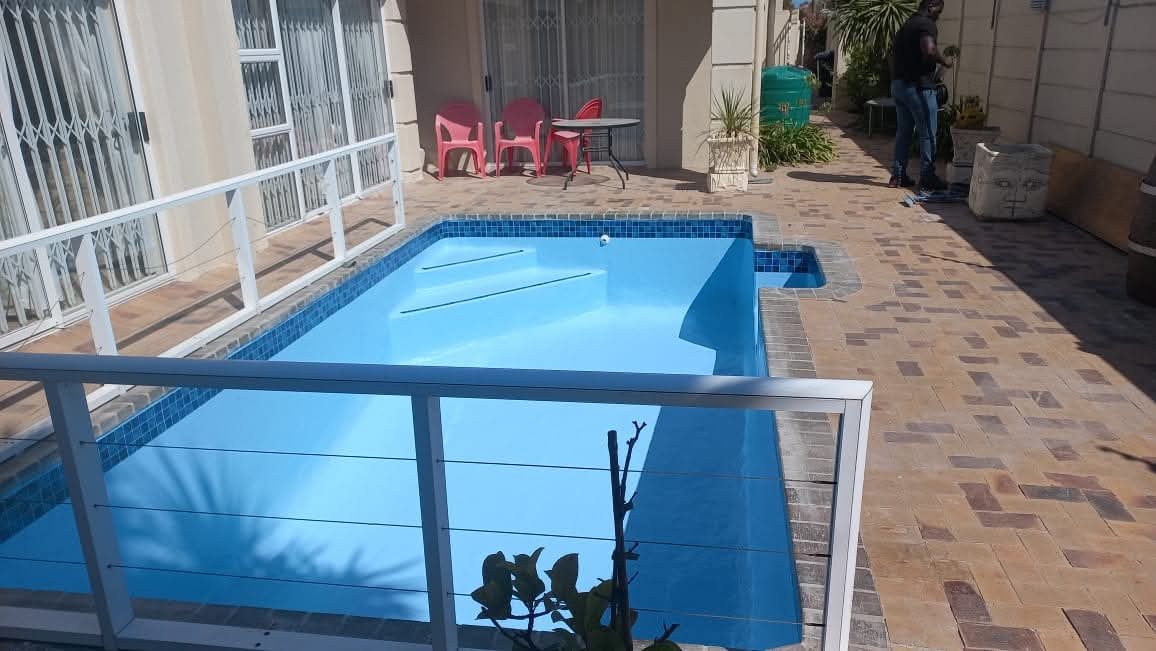
Removable mesh fences are made of PVC-coated mesh stretched between aluminium poles that slot into sleeves drilled into the paving. When the kids are older, or for a party with only adults, the fence can come down and the sleeves are capped.
They’re the cheapest option and the least intrusive. The mesh is see-through, has no footholds and is soft if a child runs into it. The catch is human: a fence that’s easy to remove is easy to leave off. If you choose mesh, decide as a family that it stays up whenever young children are around.
Check the tension and the self-closing gate every few months. Wind and sun slacken the mesh over time, and a sagging panel can leave a gap at the bottom.
Need a safe barrier around your pool?
We assess your pool area, explain the options for your layout and budget, and quote for fencing, nets or covers.
Pool safety fence rules in South Africa
The South African standard for private pools, SANS 10134, works alongside the building regulations, which require owners to control access to a pool. Your local authority, estate or HOA may add its own rules. A compliant pool safety fence generally needs:
- Height: at least 1.2m, measured from the ground on the outside.
- No gaps a child can get through: no opening that a 100mm ball can pass, including under the fence and under the gate.
- Nothing to climb: no horizontal rails, wide mesh or nearby furniture, pot plants or walls that act as a step up.
- A complete barrier: the fence must close off the pool on every side, including from the house if doors open onto the pool area.
- A self-closing, self-latching gate: see the next section.
- A net or cover as well: the standard also calls for a safety net or solid safety cover on the pool.
Our pool safety barrier checklist goes through each point in more detail, and it’s worth running through before you buy or sell a house. See our checklist for buying a house with a pool too.
The pool gate: the part of a pool fence that fails most
A fence is only as good as its pool gate. Most barrier failures we hear about are gates propped open, latches that don’t catch or hinges that have stopped closing.
- The gate should swing closed by itself from any open position and latch on the first swing.
- It should open outwards, away from the pool, so a child pushing on it can’t get in.
- The latch should sit high, around 1.5m, out of a toddler’s reach, or on the pool side with a shield.
- It should be lockable when nobody is using the pool.
Test the gate every month. Open it, let go and watch it close and latch. Salt air and sun stiffen hinges and springs, so a gate that worked last year may not today.
Pool fencing: Cape Town wind and salt air
When you choose pool fencing, Cape Town conditions matter. A barrier here has two extra jobs: standing up to the summer south-easter and surviving salt air. Coastal suburbs along the Atlantic Seaboard, False Bay and the West Coast get salt spray that eats away at cheap steel, plain fixings and lower grade stainless.
For coastal homes we suggest:
- Powder-coated aluminium or glass rather than mild steel.
- 316 grade stainless fittings, screws and latches.
- A fresh water rinse of fittings every month or two.
- Solid footings, because tall glass and mesh panels take a lot of wind load.
The same salt air works on your pool equipment, as our coastal pool equipment corrosion guide explains.
Pool fencing, a net or a cover?
Fences, nets and covers do different jobs, and the safety standard expects more than one. A fence keeps children away from the pool area. A safety net or solid cover is the second layer if someone gets through an open gate.
Nets are the most common second layer, and our guide to pool safety net prices covers what they cost. Our overview of types of pool covers explains which covers count as safety covers (a solar bubble blanket doesn’t).
Small above ground pools need barriers too if they hold more than 30cm of water.
At the time of writing (October 2026), a pool fence with a self-closing gate typically runs from around R800 to R1,500 per metre installed, and self-closing gates are often priced separately from around R2,500 to R5,000 each. Ask our team for a current quote for your layout.
Pool fencing questions
What are the rules for pool fencing in South Africa?
The national standard for private pools, SANS 10134, calls for a barrier at least 1.2m high that’s hard for children to climb, with a self-closing, self-latching gate. Gaps should be small enough that a 100mm ball can’t pass through, including under the fence. The standard also expects a safety net or safety cover on the pool as well as the fence.
What is the cheapest pool fencing option?
Removable mesh fencing is usually the cheapest, with SA suppliers listing it from around R300 to R600 per metre at the time of writing (October 2026). Powder-coated aluminium and steel cost more, and frameless glass is the most expensive. Ask our team for a current quote for your pool.
Is removable pool fencing safe?
Yes, if it’s installed properly, stays tensioned and the gate closes and latches by itself. The risk is that removable fences get taken down for a party and not put back. Treat it as permanent whenever young children are around.
Which pool fence lasts longest near the sea?
Glass with 316 grade stainless steel fittings, or well powder-coated aluminium, hold up best in salt air. Mild steel and lower grade stainless rust or stain quickly on the Atlantic and False Bay coasts. Rinse fittings with fresh water now and then to slow corrosion.
Do I still need a pool net if I have pool fencing?
Under SANS 10134, a fence alone isn’t the full picture: the standard calls for a child-proof fence plus a safety net or solid safety cover. The two work together, because gates get left open. Our team can advise on both.
Whether you need a new pool fence, a safety net or both, our pool fencing and safety net team can assess your pool and recommend a barrier that suits your home.
Get a pool safety quote
Tell us your pool size, the layout around it and your suburb. We will recommend the right mix of fencing, nets or covers and quote before any work starts.


