

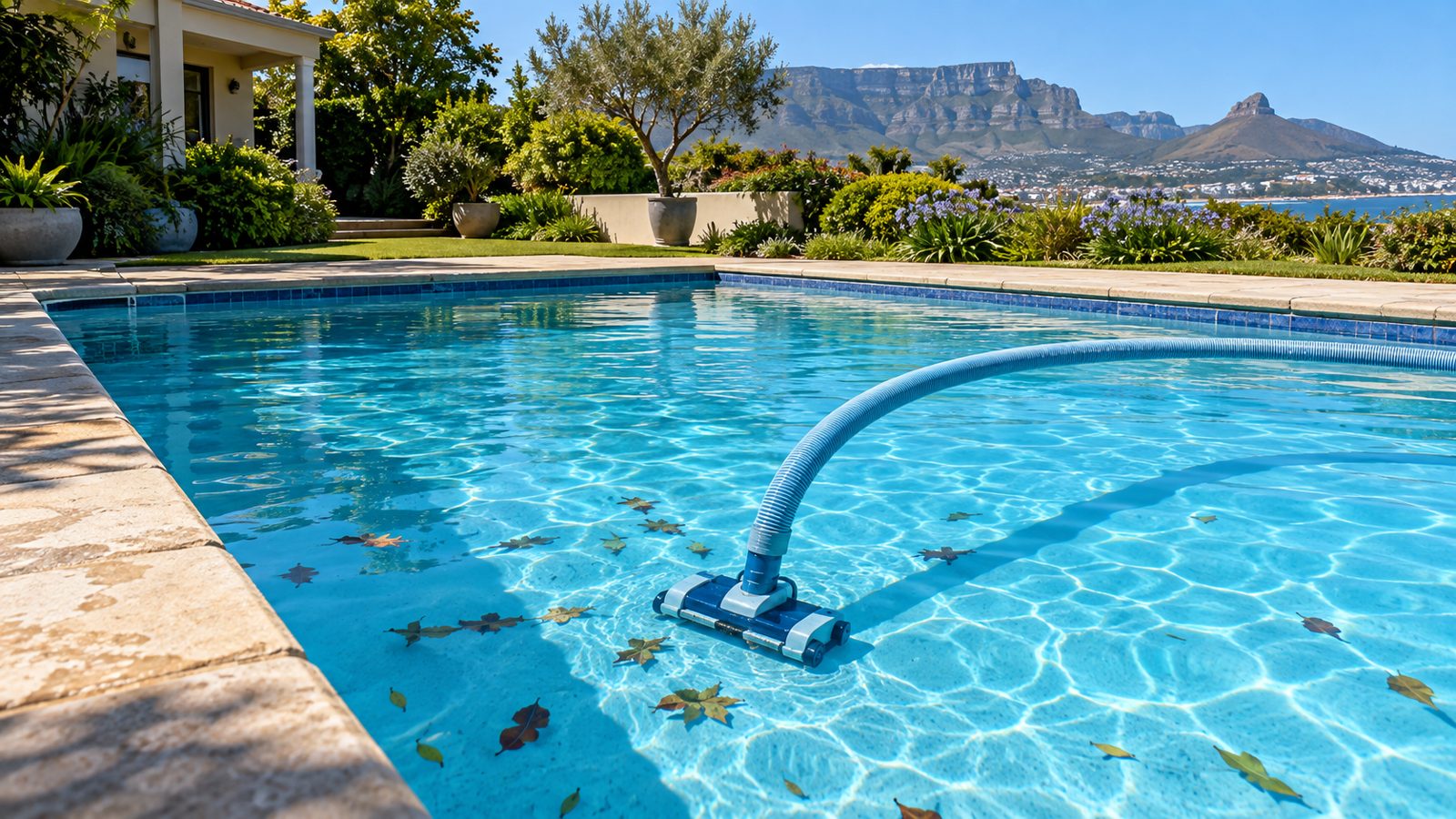
There are three main types of pool cleaners: suction-side cleaners that run off your pool pump, pressure-side cleaners that push themselves along using water from a return line, and robotic cleaners with their own motor and filter bag. Most South African home pools use a suction cleaner, because it’s cheap and works with the pump and filter you already have.
Which one suits you depends on your pump, your budget and what lands in the water. A pool under pine trees in Constantia gets a very different load to a sheltered courtyard pool. Below we compare all the types of pool cleaners, what they cost and when a weekly service beats any machine.
Types of pool cleaners compared
Here’s the short version. Prices are typical third-party retail figures at the time of writing (October 2026), not our own rates.
| Type | Powered by | Where dirt goes | From around |
|---|---|---|---|
| Suction-side | Your pool pump, through the skimmer | Pump basket and sand filter | R1,399 |
| Pressure-side | A return line, usually with a booster pump | Its own debris bag | Varies; ask for a quote |
| Robotic (cordless) | Its own battery and motor | Its own filter basket | R8,395.99 |
| Robotic (corded) | Its own motor on a low-voltage cable | Its own filter basket | R13,799.99 |
The big split is between cleaners that rely on your circulation system and those that don’t. Suction and pressure cleaners need a healthy pump, so if yours is old or noisy, see our pool pump repairs page first. A robotic cleaner just needs charging or plugging in.
Safety with robots: only use the power supply that came with a corded robotic cleaner, keep it well back from the water and plugged into an earth leakage protected socket. Never handle the supply or cable with wet hands, and keep swimmers out while it runs.
Suction pool cleaner: the kreepy krauly most pools use
A suction pool cleaner is a head on the end of a ribbed hose. The hose clips into the skimmer, or a dedicated suction point, and your pump pulls water through it. A diaphragm or flapper inside the head opens and shuts as water rushes through, and that pulsing moves the cleaner around the floor.
In South Africa, most people call any of these a kreepy krauly, after one of the first local brands. Whatever the name on the box, the parts are much the same: head, diaphragm, foot pad or disc, hose sections, a weir adaptor and a flow regulator valve.
Why it’s the default here:
- It’s the cheapest of the types of pool cleaners, from around R1,399 for an entry model at the time of writing.
- It uses the pump and sand filter you already have, so no extra electrics.
- Parts are cheap and easy to find at local pool shops.
The catch is that it depends on good flow. A pump that’s too small, a full basket or a dirty filter and the cleaner slows down or stalls. Leaves also go straight into the pump basket, so you empty it more often in autumn. If yours keeps stopping, start with our guide to a suction pool cleaner not moving.
How much pump a suction pool cleaner needs
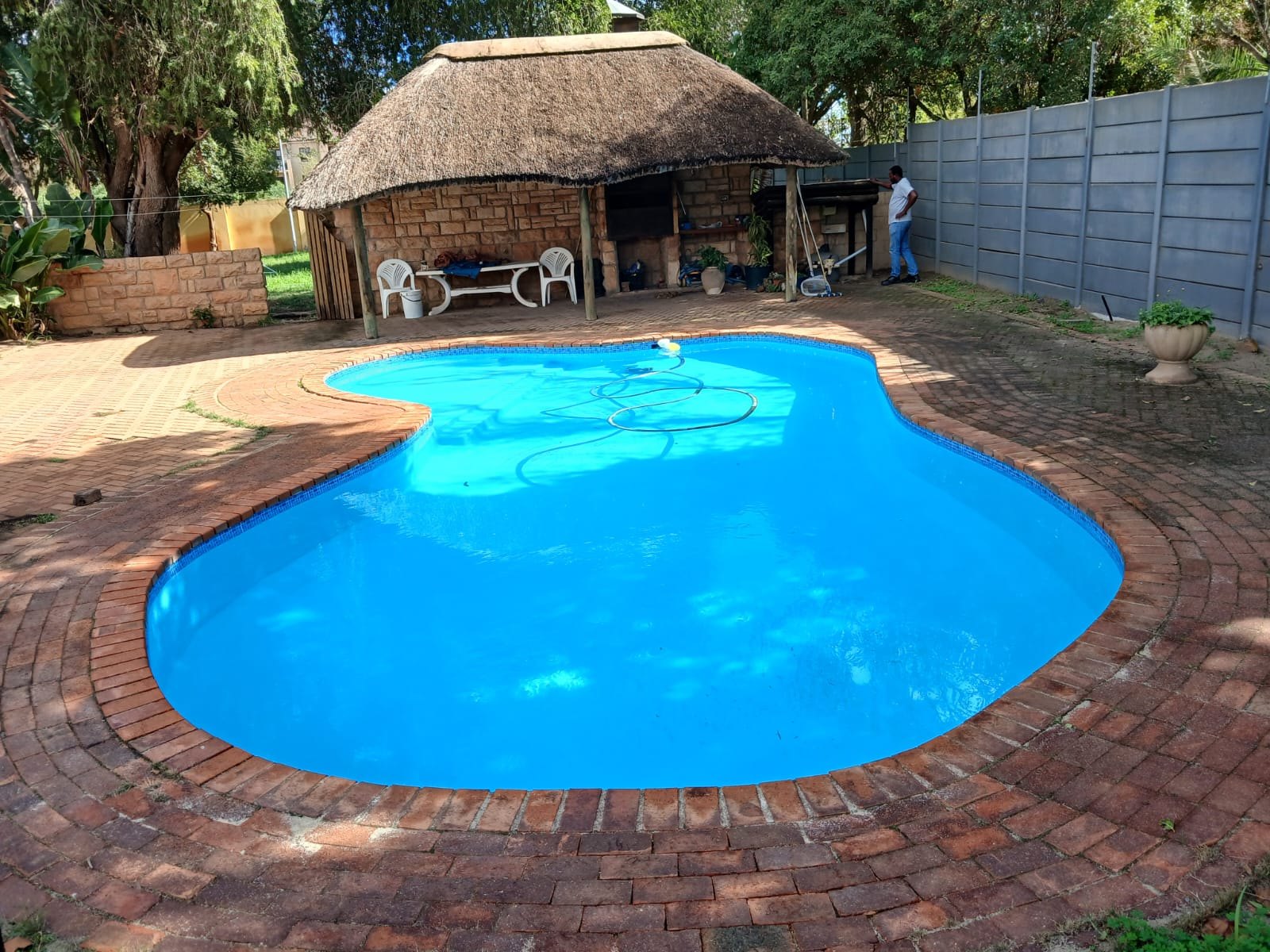
Most suction cleaners are designed to run off a typical home pump of around 0.55 to 0.75kW. The flow regulator on the skimmer adaptor lets excess water bypass the hose, so the cleaner doesn’t race around and wear out. If the pump is too weak, no adjustment will fix it. Our pool pump size guide explains how to match the pump to your litres.
Pressure-side pool cleaners
Pressure-side cleaners connect to a return line instead of the skimmer. Filtered water is pushed into the cleaner, which drives its wheels and creates a venturi that lifts debris into a bag on top. Manufacturers note that most pressure cleaners need a dedicated pressure line and a booster pump to work properly.
They’re good at picking up large debris like leaves, acorns and pebbles before it reaches the filter. That suits big pools under trees. The downside is the extra pump: more equipment, more electricity and more to maintain. They’re less common in South Africa, and most older pools weren’t plumbed for one.
Not sure which cleaner suits your pool?
We’ll look at your pump, filter, skimmer and the debris you deal with, and tell you which cleaner makes sense. We also repair the cleaners, pumps and fittings you already have.
Robotic pool cleaner
A robotic pool cleaner works on its own. It has its own motor, brushes and filter basket, and either a battery or a cable to a power supply that sits away from the water. It doesn’t use your pool pump or filter at all, so the pump can run on its normal timer while the robot does the floor and often the walls and waterline too.
What you get for the money:
- Scrubbing as well as vacuuming, with walls and waterline on many models.
- Fine dirt caught in the robot’s own filter, so less load on your sand filter and fewer backwashes.
- Low running power, since it doesn’t need the main pump.
- Programs and sometimes app control, with cordless models that keep working during power cuts.
The downsides are price and handling. At the time of writing, SA pool shops list cordless robotic cleaners from around R8,395.99 and corded models from around R13,799.99, with premium units well above that. You have to lift it out, empty the basket and charge or store it after each run. Heavy leaf fall can fill its basket quickly too.
Best pool cleaner (South Africa): match it to your pool
If you’ve searched for the best pool cleaner South Africa has to offer, you’ll find plenty of strong opinions. The truth is there’s no single winner. South Africa has every kind of pool, from tiny plunge pools to big marbelite family pools under oaks. Instead of a brand, choose the type that fits how your pool is set up:
- Check your pump and filter. If both are healthy and sized for the pool, a suction cleaner is the low-cost choice.
- Look at what falls in. Pine needles, jacaranda flowers and oak leaves clog suction hoses and pump baskets. A leaf canister on the hose helps, and pressure or robotic cleaners handle big debris better.
- Consider your surface. Fibreglass, marbelite and painted pools suit different pads, wheels and brushes. Check the cleaner is made for your finish.
- Think about power cuts. A cordless robot keeps working when the pump can’t.
- Be honest about time. A robot only helps if someone empties it and puts it on charge.
Cape Town’s summer south-easter blows dust, sand and leaves into pools, and winter rain washes soil in from the beds. Pools near the coast also deal with salt air on pumps and fittings. Any of the types of pool cleaners will keep the floor tidier, but none of them can stop that load arriving. For the windy months, our guide to wind-blown debris in the pool has more tips.
Keeping your pool cleaner working
Most cleaner problems aren’t the cleaner at all. They’re flow problems somewhere else in the system. A few habits make a big difference:
- Empty the skimmer and pump baskets at least weekly, more in autumn and after storms.
- Backwash when the filter pressure climbs. Our backwash guide shows how.
- Check the hose for splits and loose joints. A small air leak can stop a suction cleaner dead.
- Replace the diaphragm, foot pad and tyres when they wear. They’re cheap parts.
- Keep the water level at the middle of the skimmer mouth.
- Store a robot out of direct sun and rinse it after use.
If the skimmer itself is cracked or drawing air, the cleaner will never run well. Read our guide to a pool skimmer that’s not working for the signs. Pumps that lose prime, leak or trip are a job for our pool equipment repair team.
When a weekly service beats any pool cleaner
An automatic cleaner does the floor. It doesn’t brush the waterline, test and balance the water, clean the baskets or spot a pump that’s starting to fail. For many busy households, a weekly visit gives better water than the most expensive robot. Our pool cleaning service covers all of that, with your cleaner still running in between.
Pool cleaner questions
What are the main types of pool cleaners?
There are three main types of pool cleaners: suction-side cleaners that run off your pool pump through the skimmer, pressure-side cleaners that run off a return line and usually a booster pump, and robotic cleaners with their own motor and filter. Most South African home pools use a suction cleaner.
How much does a pool cleaner cost in South Africa?
At the time of writing (October 2026), entry suction cleaners sell from around R1,399. Cordless robotic cleaners start from around R8,395.99 and corded robotic models from around R13,799.99 at SA pool shops. Ask our team for a current quote if you’d like us to supply and set one up.
Is a kreepy krauly the same as a suction pool cleaner?
In everyday South African use, yes. Many people call any suction pool cleaner a kreepy krauly, even though it began as one brand name. They all work the same way, pulling water and dirt through a hose into the skimmer and on to the filter.
Why does my suction pool cleaner keep stopping?
The usual causes are low flow from full baskets or a dirty filter, a split hose letting in air, a worn diaphragm or a water level below the skimmer mouth. Check the baskets, backwash and inspect the hose first.
Do I still need a pool cleaning service if I have an automatic cleaner?
Usually, yes. An automatic cleaner handles the floor, but someone still needs to brush the waterline, empty baskets, backwash and test the water. A weekly service covers all of that, and some Cape Town pools under trees need it more than others.
Whichever cleaner you choose, it only works as well as the pump, filter and skimmer behind it. Our team handles pool pump, filter and pool cleaner equipment repairs across Cape Town.
Get your pool cleaner and pump checked
Cleaner stalling, pump struggling or basket always full? We’ll find the cause and quote before any work starts.

