

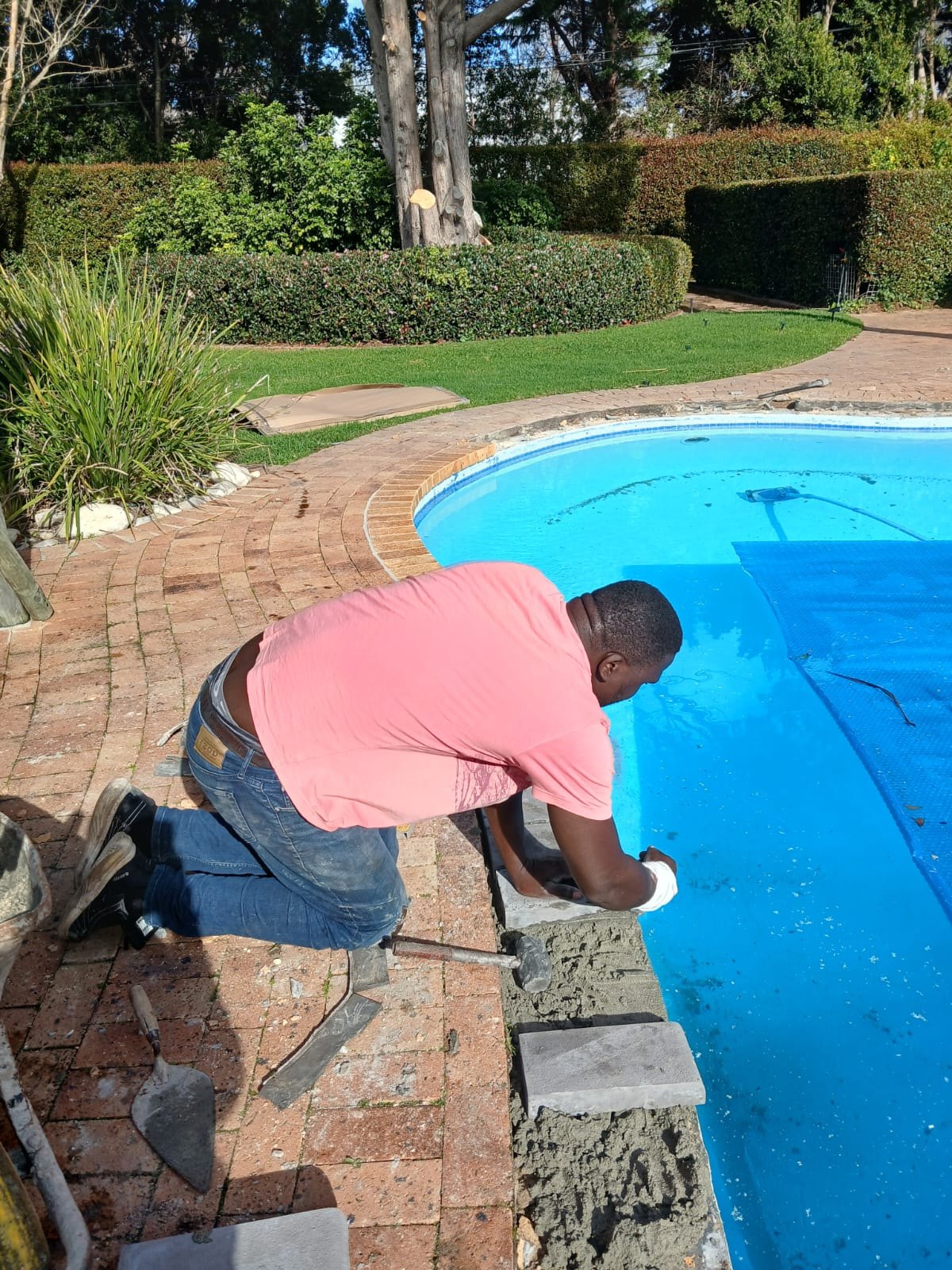
Is your pool skimmer leaking? The water may be escaping through the skimmer body, the joint where its opening meets the pool, or a connected pipe. A falling waterline near the skimmer is a useful clue, but it does not distinguish those faults. Record the symptoms and have the suspected area tested before buying sealant or agreeing to replace the box.
In South African pool conversations, the same assembly may be called a skimmer or weir box. This guide focuses on leakage around that assembly. Leaves failing to enter the basket is a different complaint, although a pool can have both problems at once.
Pool skimmer leaking: name the area you can see
The visible opening at the pool wall leads into a chamber that collects surface water and usually houses a removable debris basket. Water then travels towards the pump through connected suction plumbing. The exact arrangement depends on the model and installation, so a photograph of your own assembly is more useful than assuming every skimmer has the same internal parts.
For an enquiry, separate the wall opening, the chamber itself and the pipe connection. A crack beside the opening is not automatically a crack in the plastic body. A sound-looking chamber does not prove the connected underground line is sound, either.
Kwik Pools provides pool skimmer and weir repairs. Describe the location of the suspected loss rather than requesting a particular patch in advance. The appropriate repair depends on the confirmed defect, surrounding condition and access.
A skimmer throat crack or a failed wall joint?
The transition between a skimmer opening and the pool structure deserves careful inspection. Different materials meet here, and a visible gap may need investigation. The term skimmer throat crack is sometimes used loosely for a crack in this opening, its surrounding finish or the joint at the pool wall.
Show the assessor a wide photograph and a closer view taken from stable ground. Explain whether the mark is new, growing or reopening after an earlier patch. Do not scrape away material to make the crack easier to see, and do not press on loose edging to demonstrate movement.
Anderson Manufacturing discusses different repair approaches around the skimmer mouth and body. It also distinguishes relatively temporary putty repairs from other methods. That is a useful reason to ask what a proposed treatment is meant to achieve, rather than assuming every product described as waterproof is a permanent solution.
A surface repair may be appropriate in some situations, but it must match the actual substrate and defect. If movement or poor support remains unresolved, ask how the recommendation accounts for it. Do not accept a cosmetic improvement as proof that the original escape path has been eliminated.
What a leaking weir box can look like
A leaking weir box may have a split in its chamber or a defect near an outlet connection. Some damage is difficult to see through water or behind the basket. This does not mean the homeowner should dismantle the assembly, remove suction fittings or reach into a live opening.
With the pump safely isolated against automatic restart, a normal removable basket can be handled only as directed for the installed model. If it is jammed, the lid is broken or sharp material is present, stop and let the service professional inspect it. Never use your hand to test suction at the bottom of the chamber.
Report a distorted box, a lid that no longer fits or changing gaps around adjacent paving. These observations may affect the assessment, but they do not establish the cause. Avoid attributing damage to soil movement, poor construction or a previous contractor without evidence.
A crack is a candidate, not the whole diagnosis. A pool can lose water through more than one route. Once a skimmer defect is repaired, the original water-loss complaint still needs verification rather than an assumption that the most visible crack was the only problem.
If pool water stops at skimmer level, what does it mean?
When pool water stops at skimmer height, homeowners often take it as proof that the box is leaking. A change in loss near that level is worth reporting, but apparent stopping can be affected by measurement limits, evaporation, automatic filling and the conditions under which the pool is operating.
Other fittings or defects near a similar level may also need consideration. The important question is what testing links the observed level to a specific escape path. Give the assessor the actual timeline, not just the final position of the waterline.
Do not intentionally let the pool keep draining to find the lowest level. A low waterline can interrupt the supply to the pump, and draining a pool requires a separate assessment. If water is already too low for safe operation, stop the pump safely and obtain advice rather than continuing an experiment.
A controlled comparison with evaporation may help establish unexplained loss when conditions are safe, but this article does not substitute a level comparison for localisation. If the suspected skimmer fault is unconfirmed, ask about a broader leak investigation before selecting the repair.
Get the symptoms checked
Send Kwik Pools your observations and equipment details. Ask what assessment is appropriate before authorising repairs or buying replacement parts.
Separating a skimmer pipe leak from the box
A skimmer pipe leak involves the connected plumbing rather than necessarily the visible chamber. Because that line supplies the pump, a fault may be associated with air entering during operation. However, air can also enter at accessible equipment connections, so bubbles alone do not prove an underground skimmer-line failure.
Professional pipe isolation and testing can help distinguish the connected line from the box or pool-side joint. Ask which section is being tested and whether the chamber itself is included. A passed pipe section does not automatically clear every adjacent fitting.
Operating patterns are not infallible. In Anderson’s published skimmer case, greater loss with the pump running initially suggested pressure-side plumbing, but testing identified a cracked skimmer bowl instead. The pressure line held. The example supports testing the theory, not assuming that every similar symptom has the same cause.
| Observation | Possible investigation area | What it does not prove |
|---|---|---|
| Gap beside the wall opening | Joint, surrounding finish and support | That the plastic chamber is split |
| Visible mark inside the box | Body condition and local leak testing | That no other leak exists |
| Air appears during pump operation | Suction path and accessible seals | That the buried pipe must be replaced |
| Loss changes near opening height | Fittings and defects around that level | An exact repair location |
Ask what the proposed pool skimmer seal will fix
The phrase pool skimmer seal can refer to a joint repair, a model-specific gasket or a sealant treatment. Those are not interchangeable products. Ask the technician to identify the affected component and explain whether the proposed material is intended for the actual substrate and exposure.
For any sealant or repair compound, the manufacturer’s preparation and curing instructions take priority over a generic online recipe. This guide does not prescribe a mixture, underwater application method or refill time. A product suitable for one type of opening or pool construction may be inappropriate for another.
Ask whether the recommendation is a temporary stabilising repair, a longer-term repair or full replacement. Request an explanation of the limitations and what would trigger a different approach. A cheaper patch may be reasonable when its purpose is clearly understood, but should not be sold as equivalent to a more extensive scope without evidence.
Replacement can involve surrounding surfaces and connected plumbing as well as the box. Clarify access, matching parts, reinstatement and verification before deciding. Do not compare a tube of sealant with an installed replacement quote as though they cover the same work.
A sensible assessment-to-repair sequence
- Record the complaint. Note water-level changes, operating conditions and the location of visible defects.
- Inspect the assembly. Have the box, opening, surrounding joint and accessible connections considered together.
- Test the suspected route. Ask what evidence distinguishes the chamber, joint and pipe.
- Agree the repair scope. Confirm materials, access, exclusions and any need for specialist structural advice.
- Follow the product-specific return-to-service plan. Do not guess when the pool can be refilled or used.
- Verify the result. Keep an agreed water-loss record or obtain further testing if the original symptom continues.
Keep copies of photographs taken before the repair and the written findings. If a symptom returns, the next assessor can compare the earlier location and method rather than starting with a vague report that the skimmer was done recently.
Prepare useful information for a local visit
For pool services in Kenridge, explain how the skimmer is accessed and whether its deck lid is under movable furniture, a cover arrangement or another obstruction. Move only ordinary items that can be shifted safely. Do not lift damaged paving or dismantle barriers to improve access.
When arranging pool services in Eversdal, share earlier repair invoices or photographs if available. Identify the person who can approve further investigation once the initial findings are explained. Neither the suburb nor the age of the pool alone establishes why a particular box has failed.
Agree how findings will be communicated if you cannot attend. Request photographs of the identified defect and a clear distinction between essential work and optional improvements. That makes it easier to approve a targeted repair rather than an open-ended replacement based on an unconfirmed suspicion.
Arrange the next step with Kwik Pools
Describe what changed and what you have already checked. We can discuss a suitable assessment and the information needed for your enquiry.
Questions about skimmer leaks
Does the whole skimmer need replacing if it leaks?
Not always. The joint, body and connected pipe need to be distinguished first. A suitable repair may be possible, but its durability and limitations depend on the confirmed defect and surrounding condition.
Can a skimmer leak more while the pump runs?
Yes, operating patterns can be misleading. Anderson documents a cracked skimmer bowl that lost more during operation while pressure-side plumbing tested sound. Treat the pattern as a clue requiring confirmation.
Is ordinary silicone enough to seal the opening?
Do not choose a product simply because it is described as waterproof. The repair must suit the component, substrate, exposure and preparation requirements. Ask for the exact product and its intended role in the repair.
Should I let the water drop below the skimmer to prove the leak?
No. Do not deliberately continue water loss or run equipment without an adequate supply. Report the observed level changes and ask the professional how to investigate safely without unnecessary draining.


Comments are closed