

A pool plumbing pressure test helps a professional determine whether a defined section of pipework is losing water under controlled test conditions. It can narrow the investigation to a circuit, but a pressure drop alone does not mark the exact place to excavate. Ask which lines were isolated, what was measured and what evidence supports the proposed repair location.
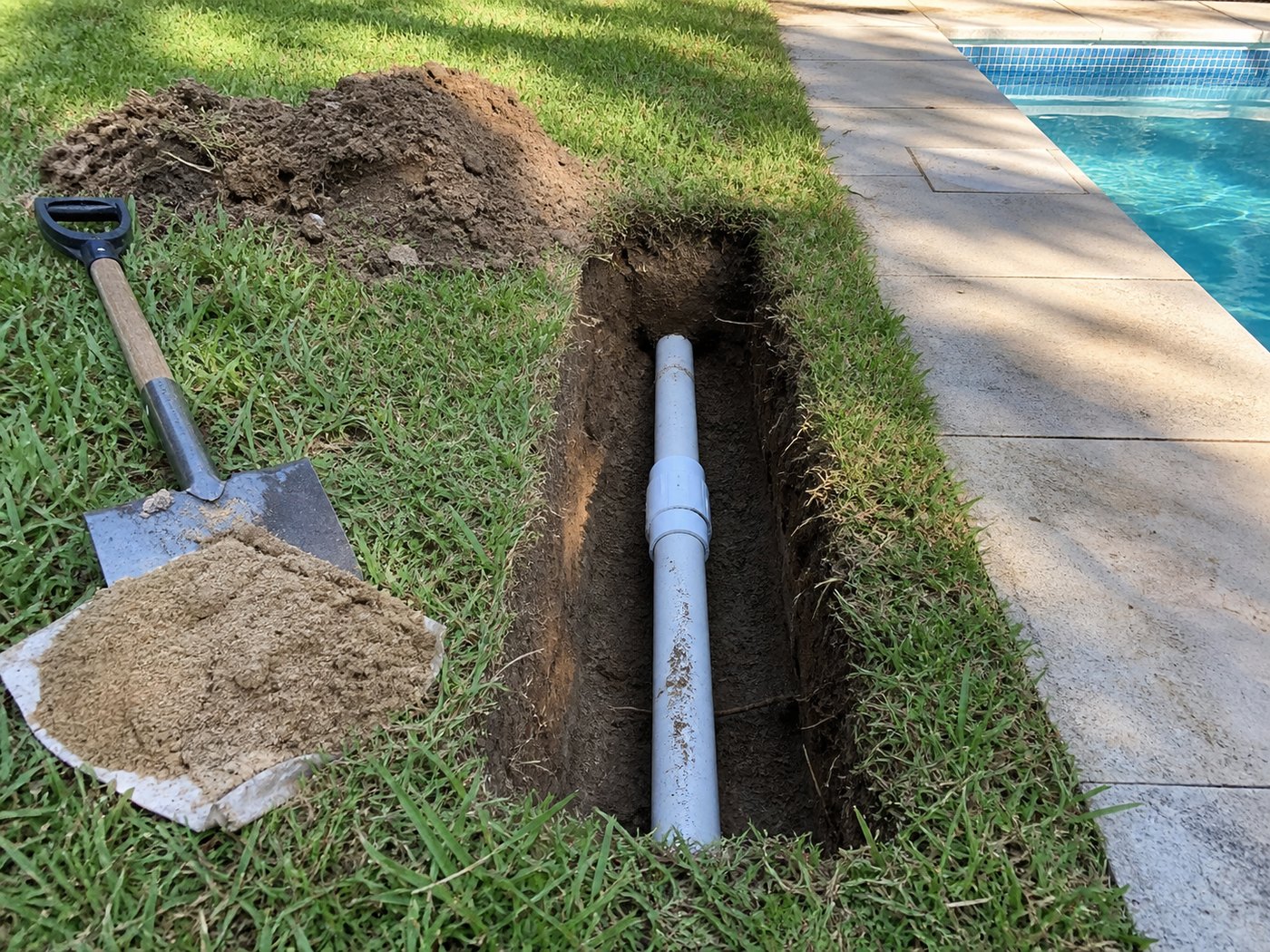
The featured image is an AI-generated illustration of exposed pipework, not a pressure-test demonstration or client work.
This is a guide to commissioning and understanding the investigation, not instructions for carrying it out yourself. Test plugs, pressurised pipework and connected equipment can create serious hazards. The technician must choose a suitable method for the actual installation and keep people clear of the test area.
The question a pool plumbing pressure test answers
A useful test starts with a precise boundary. A statement that the plumbing was tested means little if nobody can explain which pipe ends, branches and components were included. The result belongs to the section actually isolated, not automatically to every pipe buried around the pool.
In broad terms, the professional separates an intended circuit from the rest of the system and assesses whether it retains test pressure. Anderson Manufacturing distinguishes this isolation stage from the later work of locating the leak along the line. That distinction should also appear in the explanation you receive.
Do not confuse a filter pressure gauge with a dedicated leak test. The reading you see during normal circulation describes the operating system at that moment. It is influenced by flow and resistance, and cannot by itself identify a leaking underground joint.
A pool suction line leak is not a return-line diagnosis
Suction plumbing carries water towards the pump. Depending on the installation, it can include skimmer lines and other suction connections. Return plumbing carries water back towards the pool after the pump and treatment equipment. Attached features or previous alterations may add branches that are not obvious from the surface.
A pool suction line leak can admit air while the pump operates. That makes air in the pump or bubbles at returns useful information, but not proof that a buried pipe has failed. Accessible lid seals, valves and connections can produce similar symptoms and should not be ignored.
A pool return pipe leak needs its own test boundary
Greater loss while the pump runs can lead a technician to investigate return-side plumbing. It is still a starting suspicion. A skimmer fault or multiple leaks can complicate the pattern, so a pool return pipe leak should be confirmed through appropriate testing rather than assumed from the operating schedule.
Before the visit, send any existing plumbing sketch and identify changes such as an added heater, water feature or replacement pump. Do not label an unknown valve yourself. A photograph with a note saying its purpose is unknown is more useful than an incorrect circuit name copied onto a test report.
Look at visible losses before an underground pool pipe leak
An underground pool pipe leak is only one possible explanation for falling water. Visible equipment leakage, a discharge line carrying water unintentionally, evaporation and other non-pipe faults deserve attention before excavation is discussed. A good investigation works through alternatives instead of starting with the most disruptive option.
You can record wet areas from a safe position and note whether they coincide with irrigation or recent rain. Do not crawl into an equipment pit, move live electrical equipment or lean on pipework. Damp ground may be relevant, but water can emerge somewhere other than the defect itself.
- Record unexplained top-ups and any automatic filling system.
- State when water was last intentionally discharged for cleaning.
- Describe air at returns separately from the water-level change.
- Provide previous leak reports and the location of known repairs.
- Explain whether all attached features were operating when the symptom appeared.
Kwik Pools offers pool plumbing and pipe repairs. Frame the first enquiry around investigation and evidence, not a request to replace every pipe. If the fault has not been narrowed down, ask whether broader pool leak detection should precede a pipe-specific repair quotation.
What pool pipe isolation should mean in a report
Pool pipe isolation means identifying and separating a particular section for testing. The technician needs to understand connections that could otherwise allow pressure to pass into another part of the system. A valve handle position alone may not establish that the intended boundary is sound.
Ask for a simple sketch or a clear written description. It might identify a skimmer circuit or a particular return branch, with the endpoints marked in relation to visible fittings. If several branches remain connected, the conclusion should describe that combined section rather than claiming one individual branch passed.
Anderson explains that water is preferred for isolating leaks by pressure testing because trapped air compresses and can make a pressure drop harder to see. Its pressure-testing technical material separately discusses acoustic pinpointing. Those professional methods are not interchangeable home experiments.
No universal test-pressure recipe: pipe condition, components, test equipment and manufacturer limits matter. Do not attach a compressor, insert improvised plugs or ask a helper to hold a fitting closed. Leave test setup, pressure selection and safe release to the qualified specialist.
Get the symptoms checked
Send Kwik Pools your observations and equipment details. Ask what assessment is appropriate before authorising repairs or buying replacement parts.
Read the leak detection report critically
A useful leak detection report distinguishes observations, test conditions and conclusions. You do not need to audit the technician like an engineer, but you should understand what the evidence allows you to authorise. Ask for unclear language to be explained before approving destructive access.
| Report item | Why it matters | Question to ask |
|---|---|---|
| Section and endpoints tested | Defines which plumbing the finding applies to | Were connected branches tested together or separately? |
| Test method and recorded result | Separates a measured finding from an impression | What changed during the observation? |
| Checks on test connections | The temporary setup is part of the investigation | How was loss at the test arrangement ruled out? |
| Pinpointing evidence | A failed circuit is not an excavation coordinate | What supports opening this specific area? |
| Limitations and untested areas | Prevents a partial pass being treated as a whole-pool clearance | What remains unresolved? |
If a section loses pressure, the specialist should explain how the test setup and isolation were checked before attributing that loss to buried pipework. If a section holds, the conclusion should remain tied to the test conditions. Intermittent symptoms or connections outside the boundary may need a different investigation.
Ask how a result relates to the original complaint. A pipe test that holds does not explain away continuing water loss. It may usefully redirect the investigation towards the shell, fittings, equipment or another untested circuit. A clear negative finding is valuable when its limits are explicit.
From a failed circuit to a repair location
Knowing which circuit is suspect reduces the search area, but the line may travel under paving, garden beds or another structure. The original route may differ from a straight line between the pool and equipment. Plans, visible connections and further locating work help build the case for an access point.
Acoustic methods can support pinpointing in appropriate conditions. Anderson notes that sounds from air moving through water in pipe low spots can confuse interpretation, and that changing the investigation arrangement can help distinguish a genuine leak location. A single noise does not justify an absolute promise that only one paving slab will need lifting.
Ask the technician to distinguish the suspected location from a confirmed exposed defect. Sometimes careful access is needed to complete confirmation. Agree in advance what happens if the first opening does not reveal the problem, including who approves further work and how changes to cost will be communicated.
Agree excavation, reinstatement and verification
The repair scope should describe access and making good as well as the pipe itself. Lifting a surface, protecting nearby services, handling spoil and reinstating paving or landscaping are different tasks. Do not assume that a pipe-repair price includes a perfect colour match to weathered paving.
- Confirm the evidence. Obtain the tested circuit, findings and proposed location in understandable terms.
- Define access. Identify the surface to be opened and any known nearby services or property restrictions.
- Separate inclusions. List investigation, pipe repair, testing, spoil removal and reinstatement explicitly.
- Set an approval point. Agree how unexpected damage or a wider excavation will be authorised.
- Plan the handover. Request the repair location, materials used, verification result and operating instructions.
Do not refill an excavation or cover a repaired connection yourself while verification is outstanding. Ask what inspection or retesting is appropriate before reinstatement, and whether a subsequent water-level record is needed to establish that the original loss has stopped.
Prepare the local assessment visit
For pool services in Brackenfell, include gate access, equipment location and any information about buried household services near the suspected route. If plans are missing, say so. A lack of drawings is not a reason to guess where an electrical cable or water supply runs.
When requesting pool services in Kuils River, explain whether the potential access area is paved, planted or beneath a structure. Arrange for the person authorising work to receive the findings.
The best outcome is not merely a gauge that holds at the end of a visit. It is a clear explanation linking the complaint, test findings, agreed repair and verification, with remaining uncertainty recorded rather than hidden behind a broad assurance.
Arrange the next step with Kwik Pools
Describe what changed and what you have already checked. We can discuss a suitable assessment and the information needed for your enquiry.
Questions about professional pipe testing
Will a pressure test show the exact leak location?
Not by itself. It can identify a suspect tested section. Additional locating work and sometimes controlled access are needed to establish where along that section the defect lies.
Does a passed pipe test prove the whole pool is watertight?
No. It applies to the section and conditions tested. The shell, fittings, equipment and untested lines can still require assessment if the original water-loss symptom continues.
Can I do the test with an air compressor?
No homeowner procedure is recommended here. Pressurised systems and plugs create hazards, and trapped air complicates interpretation. A qualified specialist must select the method and equipment for the installation.
Should paving replacement be part of the quote?
It should be explicitly included or excluded, not assumed. Ask who handles lifting, reinstatement, waste removal and any unavoidable mismatch, and how extra access will be approved.


Comments are closed