

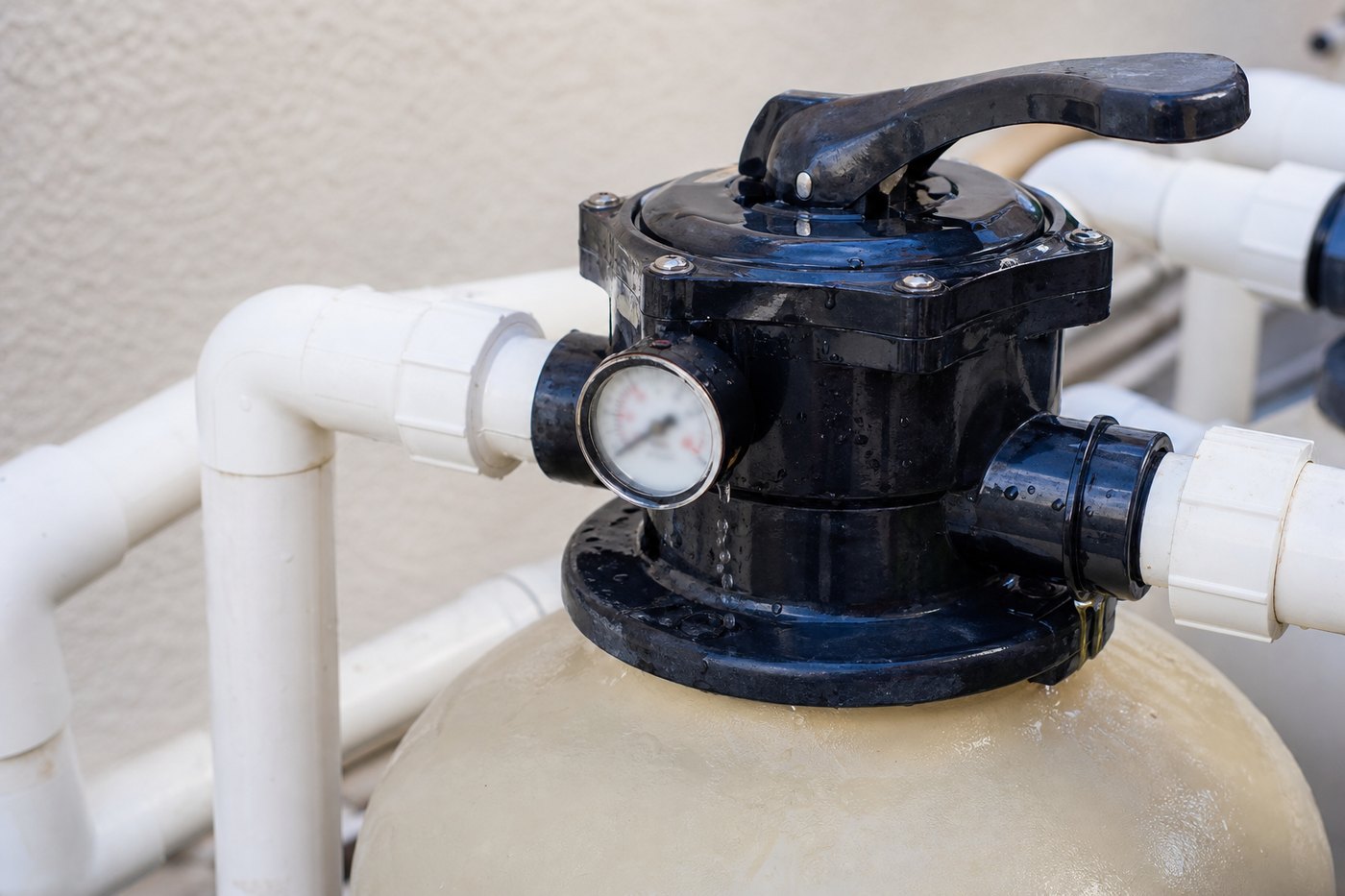
Pool filter pressure too high should be assessed against the system’s own clean operating baseline, at the same pump speed and valve arrangement. There is no single normal reading for every pool. A rising gauge can indicate resistance through the filter or return system, but a faulty gauge or changed operating conditions must also be considered.
Featured image: AI-generated illustration of a filter valve and gauge, not a client installation or a readable pressure example.
Do not loosen a filter lid, gauge or clamp to investigate a high reading. Stop the system if operation appears abnormal, a safety limit is approached or there is damage or leakage. A filter is a pressure vessel, and its warning labels and manufacturer instructions take priority over generic pressure advice.
Pool filter pressure too high compared with what?
The clean baseline is the recorded pressure after correct cleaning and normal commissioning, with the system running in its intended configuration. It is not a number borrowed from a neighbour. Pool plumbing, equipment selection, pump speed and the chosen water route all affect the reading you see.
If you have a recent service sheet, look for the pressure and operating conditions recorded together. A number without the pump speed or valve setting may be an incomplete reference. Ask the technician to establish a documented baseline if nobody knows what the system normally reads when clean and correctly set up.
The Pentair Sand Dollar and Cristal-Flo II manual explicitly records original clean operating pressure and relates cleaning to a rise above it. Its specified cleaning trigger applies to those filters. It should not be transferred to a different model as a universal rule.
Baseline and maximum are different. A clean operating reference helps identify change. A maximum permitted pressure is a safety limit, not a cleaning target or an acceptable everyday aim. If the equipment label or manual is missing, get the filter identified rather than guessing a safe limit.
Build a clean filter baseline that can be compared
For a current concern, record the reading already observed and the circumstances. Do not keep an abnormal system running while gathering a perfect set of measurements. A clear photograph of the dial taken from a safe position can capture both the number and its unit, which avoids confusion between different scales.
- Identify the filter model and whether it uses sand, cartridges or another medium.
- Record the current pressure with its printed unit and the date of observation.
- Note pump speed or operating mode if that information is already safely visible.
- State the selected normal filtration route and any recent changes to connected equipment.
- Find the last clean reference or mark it as unknown, then request professional confirmation.
Compare like with like. A variable-speed pump’s lower-speed filtration period and its higher-speed cleaning period need not produce the same pressure. A newly installed pump can also change the system operating point. Treat a change after replacement as a reason to review compatibility and commissioning, not proof that the filter suddenly became dirty.
When requesting pool filter repairs, include both old and new readings if you have them. Explain whether the rise was gradual, sudden or present immediately after servicing. This sequence helps separate accumulated resistance from a configuration change or an instrument problem.
Could it be a pool pressure gauge fault?
A gauge is a measuring instrument, not an independent safety certificate. An unreadable scale, damaged face or needle that seems fixed deserves attention. Describe what it shows with the system off as well as the earlier running reading, if both were already observed. Do not unscrew it to see whether the needle moves.
A gauge that does not return as expected can be suspect, but residual system conditions also matter. Most importantly, a zero indication alone cannot prove a vessel has been safely depressurised. The service professional must follow the complete isolation and pressure-relief procedure for the equipment rather than relying on one instrument.
Ask whether the gauge was checked for plausible operation during diagnosis. Replacing an inaccurate gauge can resolve a misleading reading, but it cannot remove a real restriction. Conversely, a new filter is not a sensible first purchase if the only evidence is a visibly damaged dial.
High pool filter pressure and a dirty filter
As a filter captures material, resistance can build and flow can fall. Pentair describes this relationship for its sand filters. In practice, the important question is whether the pressure trend responds appropriately to the correct cleaning procedure, performed for the actual filter type and its condition.
A cartridge filter is not backwashed in the same way as a multiport sand filter. Even within a filter type, the cleaning trigger and procedure should come from the model instructions. Do not add a chemical cleaner to solve a gauge reading unless the product is approved for the equipment and used as directed.
Repeatedly cleaning without understanding the result can waste water and delay diagnosis. If pressure remains abnormally elevated after proper cleaning, record the result and stop repeating the same intervention. A technician may need to consider media condition, an internal obstruction or restrictions elsewhere in the water path.
Have the pressure change assessed
Send Kwik Pools the gauge photograph, filter model and any clean baseline. Tell us if the increase followed cleaning, a pump change or other equipment work.
A blocked pool return can raise resistance
The return side carries water from the filtration equipment back to the pool. A partly closed valve or obstruction can increase resistance downstream. The Pentair troubleshooting table includes a partially closed valve or return-line restriction among causes of higher filter pressure. That is different from a suction-side shortage, which can present with weak flow and low pressure.
Do not experiment by closing and opening unidentified valves. Photograph visible labels and note any known change made before the symptom began. Where a heater, solar circuit or water feature is connected, tell the technician which route was in use. The correct water path depends on the actual installation, not a diagram of someone else’s pool.
If a rise began after motor or pump replacement, a pump-system assessment may be needed alongside filter inspection. Selecting a larger pump is not a general cure for poor circulation. Equipment must operate compatibly with the filter, plumbing and other connected components.
Observe return behaviour from the deck without putting a hand into a suction opening or removing pool fittings. Weak visible circulation can support the observation that flow has changed, but it does not measure the total flow or identify the exact blocked component. Keep the distinction between a useful clue and a confirmed finding.
Sand filter backpressure after recent servicing
For a sand-filter system, report whether media work, backwashing or valve maintenance preceded the rise. Ask the service provider to check that the filter was recommissioned to the correct arrangement. Do not assume that fresh media means every other part of the circulation system is functioning normally.
A rising pressure soon after cleaning can also accompany a heavy material load from the pool. Tell the technician about recent cloudy or dirty water, but do not attribute every quick rise to algae without water assessment. The filter captures suspended material; it does not replace the need for appropriate water treatment.
| Pattern in your notes | Useful question | Avoid assuming |
|---|---|---|
| Gradual rise from a known clean reference | Is the model-specific cleaning trigger reached? | That every filter uses the same threshold |
| Sudden rise after equipment work | Did configuration or flow change? | That new media is already worn out |
| High reading after correct cleaning | Is there remaining resistance or a gauge issue? | That more backwashing must fix it |
| Unmoving or unreadable gauge | Can the instrument be verified? | That the displayed pressure is reliable |
Know the pressure-vessel boundary
Keep clear of filter closures during abnormal operation. Do not tighten a leaking clamp while the pump runs, crack a union open to release pressure or move a multiport handle under power. Pentair warns that pressurised air can force closures apart and requires the pump to be off before valve positions are changed.
This guide deliberately does not give a universal depressurisation sequence. Filters differ, and damaged or missing parts make routine instructions unsuitable. Have a qualified person isolate the installation, release pressure using its approved procedure and verify safe access before service. The same care is required when returning the system to operation.
Arrange a useful local assessment and handover
For pool services in Somerset West, supply photographs of the full filter and surrounding pipework as well as the dial. Explain whether the technician can stand clear of the tank and reach the normal controls. Do not move a heavy tank or dismantle an enclosure to improve access yourself.
If enquiring through pool services in the Helderberg, include the property address, access arrangements and any prior service records. These details help plan the visit. They do not imply a particular local pressure problem or that every installation in the area has the same filter.
- Ask for the confirmed cause, not simply a replacement recommendation.
- Request the clean pressure, unit and operating mode in writing.
- Confirm the cleaning trigger for your filter model.
- Have any remaining gauge, valve or equipment compatibility issue recorded.
After work is complete, the useful outcome is a stable, explainable reading with appropriate circulation, not merely a smaller number. Keep the handover with the manual so future readings can be compared consistently. If the pressure rises again under the same conditions, report the new trend instead of changing settings to hide it.
Replace guesswork with a recorded baseline
Contact Kwik Pools for a filter assessment. Bring the manual, readings and recent work history so the repair scope addresses the cause of the pressure change.
Common questions
What pressure should every pool filter run at?
There is no universal reading. Compare the system with its own clean operating baseline at the same pump speed and water route, and follow the specific equipment limits.
Should I backwash whenever the gauge looks high?
Not automatically. Identify the filter type, baseline and manufacturer cleaning trigger first. Persistent high pressure after correct cleaning needs investigation rather than repeated backwashing.
Does a zero gauge mean I can open the filter?
No. A gauge reading alone is not proof of safe depressurisation. Isolation, pressure relief and access must follow the equipment instructions, with qualified help if anything is uncertain.
Why did pressure rise after a new pump was installed?
The operating flow and resistance may have changed. Ask for a compatibility and commissioning review, including valve arrangement and the clean baseline, rather than assuming dirt is the cause.


Comments are closed